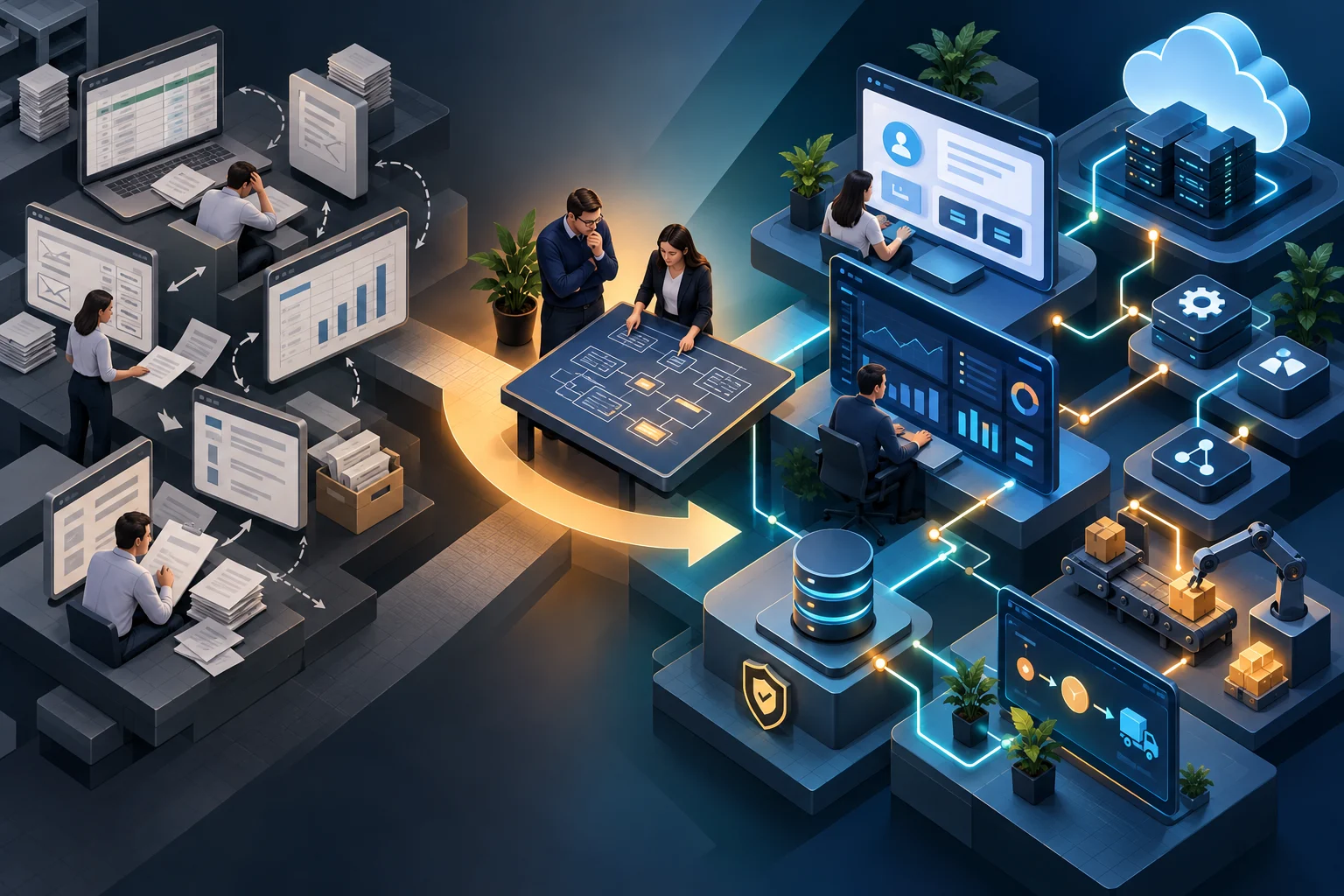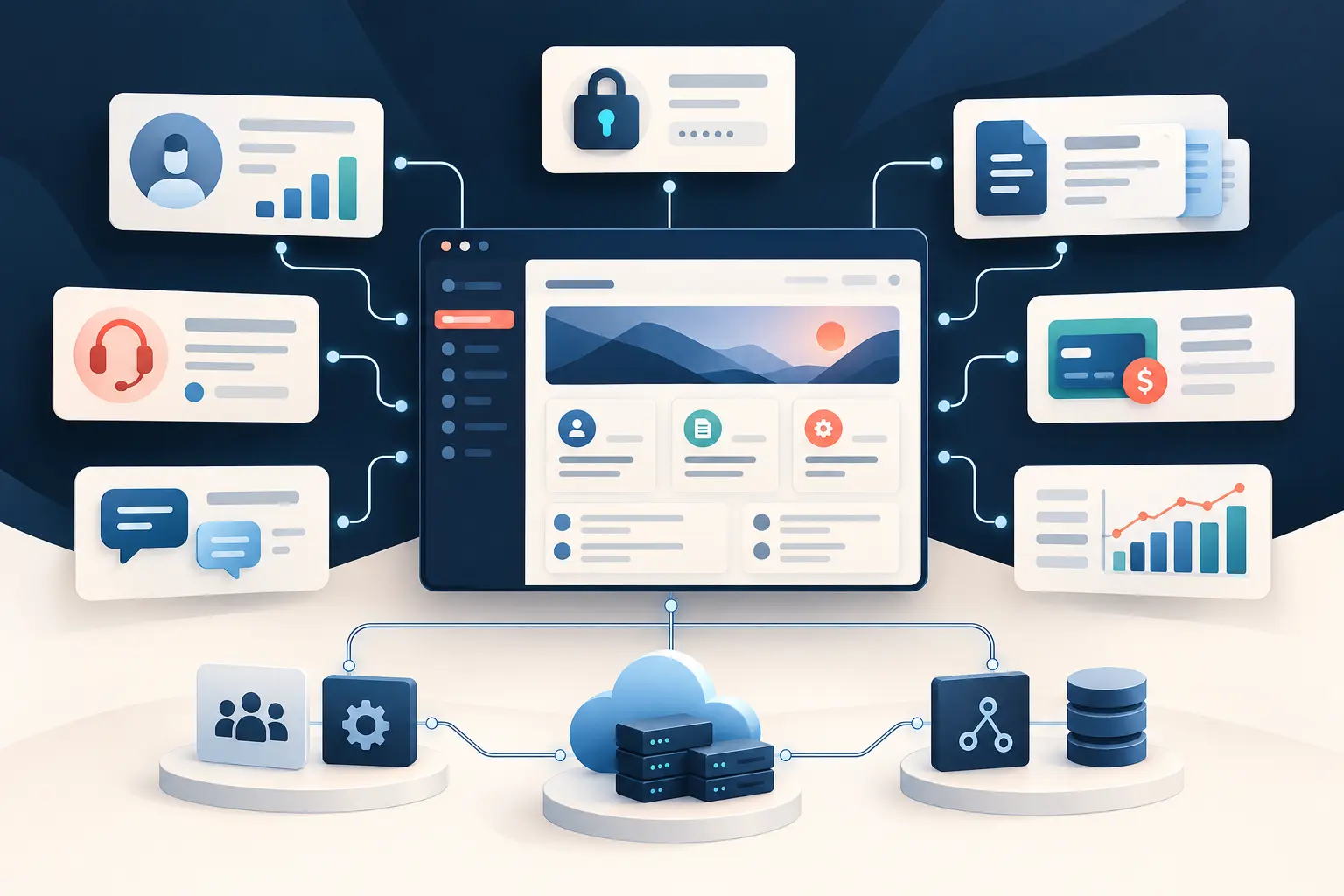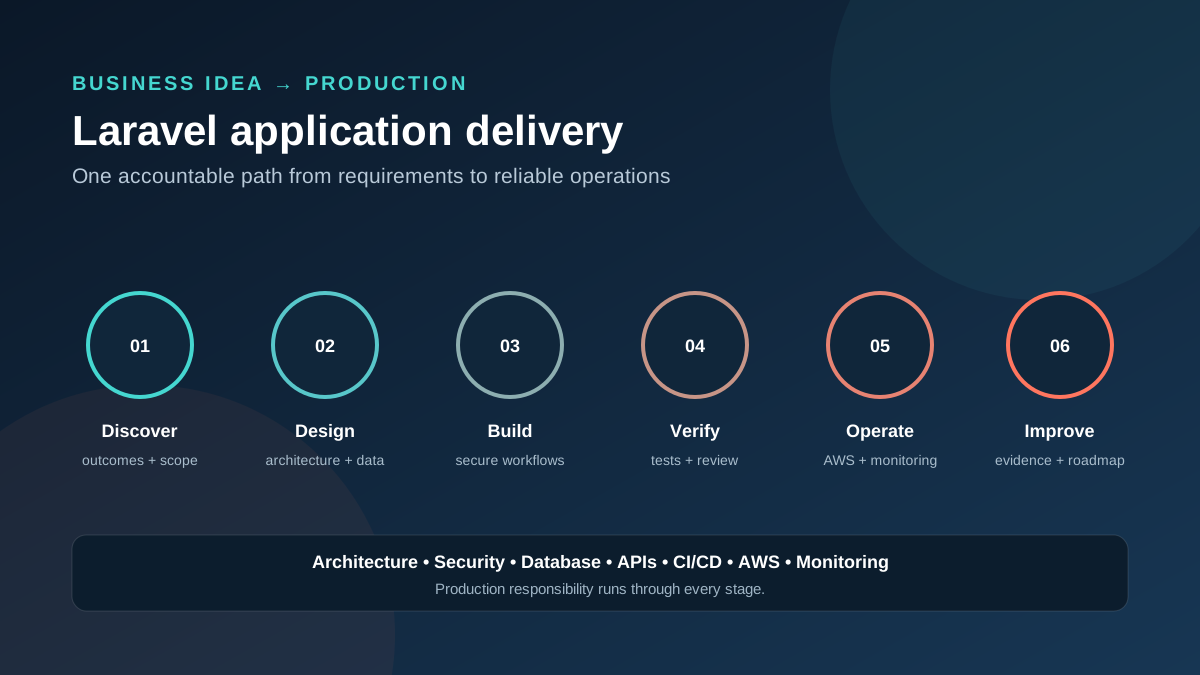
Laravel application development services should deliver a working business capability in production, not merely a collection of PHP files. When a company buys these services, it is purchasing the analysis, engineering, delivery, and operational work required to turn an idea into software that real users can trust.
That distinction matters. A developer can complete assigned tickets while leaving essential questions unanswered: Who owns the data? What prevents one customer from seeing another customer’s records? What happens when a payment succeeds but its webhook arrives twice? How is a failed release reversed? Who receives an alert when a critical integration stops? An experienced Laravel development partner owns those questions with the client from discovery through production.
This guide is specifically about what a buyer receives during a complete engagement. It complements our broader Laravel application development guide, the detailed Laravel development process, and our guide to evaluating a Laravel development company. Those pages explain the framework, the overall process, and provider selection in depth; here, the focus is accountable delivery.
What Are Laravel Application Development Services?
Laravel application development services are the coordinated activities needed to define, build, release, operate, and improve custom software using Laravel and PHP. Depending on the engagement, they include product discovery, requirements, interface design, application architecture, database modeling, authentication, authorization, APIs, integrations, automated testing, CI/CD, AWS infrastructure, monitoring, maintenance, and roadmap development.
Laravel supplies excellent conventions for routing, validation, database access, security controls, events, notifications, caching, and testing. Those capabilities make PHP Laravel development productive, but they do not make architectural decisions automatically. The team must still understand the business, decide where rules belong, enforce data integrity, design for provider failures, and establish a production operating model.
The useful output is therefore broader than source code. A client should receive a prioritized scope, documented assumptions, understandable architecture, an owned repository, repeatable environments, reviewed code, tests around important behavior, a controlled release path, operational visibility, and a clear plan for what happens after launch.
What Can a Business Build With Laravel?
Laravel web application development works especially well when software must combine secure users, structured data, proprietary workflows, integrations, and administration. Common examples include:
- SaaS platforms with organizations, subscriptions, entitlements, team roles, usage controls, tenant isolation, and administrative support tools.
- Customer and partner portals for documents, orders, service requests, approvals, project status, billing, and secure communication.
- Internal business applications for quoting, case management, inventory, fulfillment, compliance, vendor management, or specialized operations.
- Workflow automation systems that replace spreadsheet handoffs, duplicate data entry, inbox approvals, and manual reconciliation.
- Marketplaces that coordinate buyers, sellers, listings, transactions, commissions, disputes, and platform administration.
- Booking systems with availability, capacity, resources, payments, reminders, cancellations, and calendar integrations.
- Ecommerce applications with nonstandard catalogs, pricing, subscriptions, checkout, fulfillment, returns, or customer-service workflows.
- APIs and dashboards supporting mobile apps, partners, devices, governed metrics, reporting, exports, and operational actions.
- Applications integrating AI services for extraction, classification, search, summarization, drafting, recommendations, media generation, or controlled automation.
The framework is rarely the limiting factor. The important decision is whether custom software creates enough value to justify owning it. Our article about custom Laravel development addresses that build-versus-buy decision; the Laravel application development service page outlines how Custom PHP Design can help with implementation.
The Difference Between Writing Laravel Code and Owning Production
Someone hired only to write code can reasonably wait for complete requirements, implement the requested screens, and stop when the ticket passes a demonstration. That can work when a capable product and engineering organization already owns architecture, security, infrastructure, testing, release management, and operations.
Most businesses seeking custom Laravel development services need more. They need a partner who notices missing decisions, challenges unsafe assumptions, translates business language into acceptance criteria, and accepts responsibility for how the whole system behaves. Production ownership changes the questions asked before code is written.
| Concern | Code-only implementation | Production-capable development partner |
|---|---|---|
| Requirements | Implements supplied tickets | Finds missing rules, exceptions, priorities, and acceptance criteria |
| Architecture | Chooses what is convenient now | Balances delivery speed, system boundaries, deployment, and future change |
| Data | Creates tables for screens | Defines ownership, constraints, transactions, indexes, retention, and migration |
| Security | Adds login and hides buttons | Models authorization, tenant boundaries, secrets, abuse, and audit needs |
| Integrations | Demonstrates a successful API call | Handles timeouts, duplicates, retries, reconciliation, and provider changes |
| Release | Uploads code | Uses CI/CD, compatible migrations, health checks, rollback, and approvals |
| Operations | Waits for users to report problems | Establishes logs, metrics, alerts, backups, recovery, and incident ownership |
A strong Laravel application development company does not make the system needlessly elaborate. Production experience often leads to simpler choices: a modular monolith instead of premature microservices, a managed database instead of a hand-built cluster, and a few meaningful alerts instead of an unreadable monitoring wall. The difference is that those choices are deliberate and supportable.
What You Receive Across the Application Lifecycle
Discovery and requirements
Discovery identifies the business problem, users, current workflow, desired outcome, constraints, dependencies, and measures of success. The team examines normal paths and exceptions: approvals that are rejected, records that need correction, payments that fail, and integrations that become unavailable. Existing software, spreadsheets, reports, and provider documentation are useful evidence.
The deliverable is not necessarily a massive specification. It is a shared model of the problem, a prioritized release boundary, explicit assumptions, known risks, and acceptance criteria for the first valuable workflows. Good discovery reduces the chance of building the wrong system efficiently.
Architecture and technical direction
Architecture translates the operating reality into application boundaries. The team decides how interfaces, domain rules, data access, integrations, and long-running work interact. It chooses a frontend approach appropriate to the product, defines environments, and records consequential decisions so future developers understand why they were made.
For many applications, a well-structured Laravel monolith provides the best balance of transactional integrity, understandable deployment, and development speed. Separate services should appear when a measured requirement justifies their operational cost—not because a diagram looks more sophisticated.
Database design and data migration
The database encodes durable business meaning. Service deliverables should include entities and relationships, valid states, uniqueness rules, foreign keys, indexes, transaction boundaries, retention decisions, and a plan for growth. Eloquent models make data convenient to use, but database constraints protect promises across every code path.
If an existing system is involved, migration is a product capability. The team maps identifiers and fields, identifies duplicates, rehearses transformations, validates record counts and totals, plans cutover, and defines recovery. A clean import is not enough if the new system silently changes what a status or balance means.
Authentication and authorization
Authentication verifies identity. Authorization determines what that identity may see and do. Laravel provides sessions, password resets, verification, policies, gates, and API token options, while the project still needs an explicit access model covering organizations, roles, records, support access, administrative actions, and tenant separation.
Every protected operation requires server-side enforcement. High-impact actions may need multi-factor authentication, recent re-authentication, a second approval, or an audit trail. Tests should prove forbidden access, not merely confirm that intended access works.
APIs and third-party integrations
Laravel can connect CRMs, ERPs, accounting platforms, payment processors, shipping services, identity providers, email systems, cloud storage, social platforms, analytics, and proprietary business software. Delivery includes credential protection, validation, rate-limit handling, timeouts, bounded retries, webhook verification, idempotency, logs, and reconciliation tools.
Production integrations are designed around partial failure. A provider may accept an operation while the response is lost, deliver the same event multiple times, or change a payload. The application needs durable knowledge of intent and outcome, along with a safe way for an administrator to investigate and recover.
Queues, long-running work, and automation
Exports, media processing, large imports, notifications, and slow provider calls should not trap users in a browser request. The execution model must fit the deployment. Some environments use managed queue workers; self-contained applications can launch bounded detached server processes from authenticated actions or respond to external completion webhooks.
Regardless of mechanism, the deliverable includes explicit status, duplicate prevention, timeouts, resource limits, retry policy, failure visibility, and recovery. Core application behavior must not depend on an unmonitored process that nobody is responsible for running.
Testing, code review, and security
Testing should protect the business risks, not chase a decorative coverage number. Unit tests verify isolated calculations. Feature tests cover routes, policies, validation, database effects, and responses. Contract tests protect provider and API boundaries. A small number of browser tests can verify registration, checkout, booking, approval, or other critical journeys.
Security runs through design and implementation: least privilege, protected secrets, server-side authorization, secure sessions, validated uploads, dependency review, rate limits, tenant boundaries, safe logging, and backup protection. Code review, static analysis, formatting, and repeatable automated checks make defects easier to catch before release.
CI/CD, deployment, and AWS infrastructure
A deployment should be repeatable enough that releasing is an engineering procedure rather than an act of memory. CI/CD may install locked dependencies, compile assets, run automated checks, create an artifact, deploy it, apply backward-compatible database changes, verify application health, and preserve a recovery path.
AWS can provide compute, managed MySQL or PostgreSQL, S3 object storage, email, caching, secrets, logs, metrics, load balancing, and backups. Not every application needs every AWS service. The AWS and Laravel DevOps design should match availability, traffic, recovery, compliance, and budget requirements. For more detail, see our practical guide to AWS DevOps and CI/CD.
Monitoring, maintenance, and continued development
Launch begins the operating lifecycle. Useful monitoring covers application exceptions, response time, database pressure, resource health, integration failures, long-running work, backup status, and the critical business operations that infrastructure metrics cannot see. Alerts need an owner and an actionable threshold.
Continued development uses user feedback and production evidence to prioritize improvements. Maintenance includes security updates, framework and dependency upgrades, provider changes, performance work, incident diagnosis, and recovery verification. Our Laravel maintenance and support guide explains how to structure that responsibility after launch.
What Happens During the First Few Weeks?
Prospective clients often understand the final goal but not the working rhythm. Exact timing varies, especially for inherited applications and integration-heavy projects, but the opening weeks of a healthy engagement usually look like this.
Week one: establish shared context
The team interviews decision-makers and representative users, reviews the current workflow, inspects existing systems, identifies authoritative data, and confirms the desired business outcome. Access to repositories, infrastructure, vendors, and documentation is inventoried. The partner begins a risk register and records unanswered decisions.
By the end of the week, both sides should understand the first release at a useful level: who it serves, which workflow it completes, what remains outside scope, and which uncertainties could change the plan.
Week two: make consequential decisions visible
The team turns workflow knowledge into acceptance criteria, early interface flows, a domain model, permissions, integration boundaries, and an initial architecture. It establishes local and nonproduction environments, repository practices, automated checks, and a delivery backlog. For an existing application, this period may emphasize dependency, schema, deployment, and production-behavior assessment.
The client reviews real decisions—not a technical performance. Examples include who can approve a request, which system owns a customer record, how failed synchronization is resolved, and what must be in the first release.
Weeks three and four: deliver a vertical slice
Implementation begins with a narrow path that crosses the actual system: interface, validation, authorization, business rules, database, tests, and deployment to a review environment. A vertical slice exposes false assumptions earlier than building all screens first and connecting behavior later.
Regular demonstrations show working software against acceptance criteria. Decisions, scope, risks, and estimates are updated as evidence appears. Infrastructure and observability are developed alongside features so production readiness does not become a rushed phase at the end. The client should know what changed, what was learned, what is next, and where a decision is needed.
What Should a Business Prepare Before Making Contact?
You do not need a complete technical specification before contacting a custom Laravel development company. A capable partner should help turn operational knowledge into technical requirements. The most useful preparation is a concise description of:
- The business problem: what is slow, risky, expensive, impossible, or frustrating today?
- The users: customers, staff, partners, administrators, and anyone with different access needs.
- The workflows: what triggers the work, which decisions occur, what exceptions happen, and what marks completion.
- The integrations: payment, CRM, accounting, identity, email, logistics, social, AI, or proprietary systems that must exchange data.
- Existing systems and data: applications, repositories, spreadsheets, databases, reports, vendor contracts, and operational dependencies.
- Approximate priorities: what must exist in the first release, what would be valuable later, and what can remain manual initially.
- The desired outcome: reduced handling time, customer self-service, a new revenue product, fewer errors, improved visibility, or replacement of an at-risk system.
Budget range, desired timing, compliance needs, and known deadlines are also helpful because they shape the release strategy. Imperfect information is normal. Honest unknowns are more useful than invented certainty.
How AI-Assisted Development Changes Delivery
AI-assisted development can reduce implementation time for scaffolding, routine interfaces, test drafts, codebase investigation, documentation, refactoring suggestions, and repetitive integration plumbing. In experienced hands, that leverage creates more room for careful review and faster feedback from working software.
AI does not replace engineering accountability. It does not own the business outcome, choose trustworthy boundaries, understand every production constraint, approve a database migration, protect secrets, verify authorization, operate AWS, investigate an incident, or decide whether generated code is maintainable. Experienced engineers remain responsible for architecture, security, testing, code review, deployment, and production reliability.
The right question is not whether AI wrote a portion of code. It is whether a qualified person reviewed the behavior, understood the dependencies, tested meaningful risks, and remains accountable for the release. See why AI-assisted software still needs experienced developers and our guide to building SaaS faster with AI without sacrificing quality.
How to Evaluate the Scope and Engagement
A useful proposal connects effort to outcomes and deliverables. It identifies assumptions, exclusions, dependencies, client responsibilities, acceptance criteria, environments, source-code ownership, deployment authority, and post-launch support. It should explain how uncertainty will be reduced rather than hiding every unknown inside a fixed number.
Cost is driven by workflows, permissions, interfaces, integrations, migration, infrastructure, security, testing, and operating expectations. A focused application can cost far less than a multi-tenant marketplace with payments and data migration, even if both have a similar number of screens. Our dedicated Laravel development cost guide covers pricing factors and engagement models without turning estimates into false precision.
Ask the potential partner to describe a production failure, how it was diagnosed, how service was restored, and what engineering change followed. Ask who owns cloud accounts, source repositories, domain services, backups, credentials, and provider relationships. Good answers reveal whether the provider has operated real applications or only delivered code.
Frequently Asked Questions
What are Laravel application development services?
They are the complete services needed to take a Laravel application from business discovery through requirements, architecture, database design, secure development, integrations, testing, deployment, monitoring, maintenance, and continued improvement.
How much does Laravel application development cost?
Cost depends on business workflows, roles, interfaces, integrations, existing data, migration risk, infrastructure, security, testing, and support. A technical assessment or focused discovery phase normally produces a more defensible estimate than a generic package price.
How long does it take to build a Laravel application?
A focused internal tool or first release may take several weeks. A SaaS platform, marketplace, complex integration product, or legacy replacement commonly takes several months and should be released in stages. See the detailed guide to Laravel application timelines.
Is Laravel good for SaaS development?
Yes. Laravel supports accounts, organizations, team roles, subscriptions, APIs, notifications, administration, background work, and strong database patterns. SaaS reliability still depends on deliberate tenant isolation, billing-state handling, security, tests, and operations.
Can Laravel integrate with existing business systems?
Yes. Laravel can exchange data with CRM, ERP, accounting, payment, identity, storage, social, logistics, analytics, AI, and proprietary systems. Reliable integration requires failure handling, idempotency, monitoring, and reconciliation in addition to API connectivity.
Can an existing PHP application be migrated to Laravel?
Yes. A safe migration preserves valuable business behavior, adds tests around critical paths, maps data deliberately, and modernizes in controlled stages when practical. Our legacy PHP modernization service focuses on reducing risk without discarding working value.
Does Laravel work well with AWS?
Yes. Laravel works well with AWS compute, managed databases, S3, email, caching, secrets, load balancing, logs, monitoring, and backups. The implementation should remain proportional to the workload and include a documented deployment and recovery path.
How do I choose a Laravel development company?
Look for concrete production experience across architecture, database design, security, integrations, testing, CI/CD, AWS, monitoring, recovery, and maintenance. Choose a team that clarifies outcomes and risks, gives you appropriate ownership, and can explain tradeoffs without hiding behind framework terminology.
From Business Idea to an Operable Laravel Application
Professional Laravel development services turn a useful idea into a system the business can safely operate and continue improving. The code matters, but so do the decisions, tests, deployment controls, infrastructure, visibility, and maintenance practices around it.
If the real need is broader than Laravel, review custom PHP development services. If the business already has an application, support or modernization may be a better first engagement than a new build. A trustworthy partner should recommend the smallest approach that produces a durable outcome.
Custom PHP Design provides custom Laravel application development services spanning business discovery, architecture, APIs, integrations, AWS delivery, CI/CD, production operations, and long-term development. If you are evaluating a new application or an existing PHP system, start a conversation about the business outcome and a practical first phase.