Searching for the best Laravel development company produces lists, badges, hourly rates, and polished portfolios. None of those proves that a team can protect your data during a migration, reconcile a duplicated webhook, roll back a failed release, or diagnose an intermittent production problem. For a business owner, founder, CTO, or technical decision-maker, “best” only has meaning in the context of a particular application and its risks.
The right partner for a focused internal workflow may be wrong for a multi-tenant SaaS platform. A strong greenfield product team may not have the patience or forensic skill to modernize a decade-old PHP system. This guide provides a practical way to compare Laravel specialists using evidence: how they think about architecture, data, integrations, delivery, operations, ownership, and the total cost of maintaining the software. For framework-neutral vendor selection, use the broader guide to what to look for in a custom PHP development company.
What a Laravel Development Company Actually Does
A Laravel development company turns business rules into an application that can be operated safely. Coding routes, controllers, models, and interfaces is only one part of that responsibility. The engagement may include discovery, workflow mapping, application architecture, UX implementation, database design, API contracts, automated tests, infrastructure, deployment, monitoring, documentation, maintenance, and incident response.
Typical work includes custom business applications, customer or vendor portals, SaaS platforms, ecommerce workflows, REST APIs, billing and identity integrations, legacy PHP modernization, framework upgrades, performance remediation, and continued development of an existing Laravel product. A useful overview of the full delivery path appears in our guide to Laravel application development services.
Clarify boundaries before comparing proposals. Does the company own product discovery or expect finished specifications? Who handles interface design? Who designs and operates AWS? Who responds when a deployment fails? “Full service” is not a deliverable. Named responsibilities, artifacts, access, and acceptance criteria are.
When to Hire a Laravel Specialist Instead of a General Web Agency
A general agency can be a good choice when brand, content, campaigns, and a conventional marketing site are the center of the project. A specialist becomes more valuable when software behavior, operational data, or production continuity creates most of the risk.
- The application contains custom approvals, calculations, permissions, reporting, subscriptions, or multi-tenant data.
- Several external providers must remain consistent despite timeouts, duplicate events, rate limits, or outages.
- An existing Laravel application generates revenue or supports daily operations and cannot tolerate casual releases.
- A legacy PHP application must be modernized while preserving business rules, URLs, records, and continuity.
- Performance depends on database queries, caching, background work, storage, or infrastructure—not merely frontend assets.
- Your team needs focused Laravel development consulting for architecture, delivery, security, or a difficult production problem.
If the requirement is mostly publishing pages, use a CMS or hosted platform unless custom behavior creates a real business advantage. Good specialists should say when Laravel is unnecessary. For fuller framework and business-context decisions, see the Laravel development guide for 2026 and the Laravel application development guide for businesses.
Start With Architecture and Application Design Experience
Architecture is not the number of layers in a diagram. It is the set of boundaries and decisions that make important behavior understandable and safe to change. Ask a candidate to explain how it would separate HTTP concerns, validation, authorization, business operations, persistence, and third-party communication for your use case.
A credible answer may mention thin controllers, Form Requests, policies, services or actions, domain events, transaction boundaries, and interfaces around external systems. It should also acknowledge tradeoffs. A small application does not need an elaborate pattern library; a complex application should not place every business rule inside controllers or Eloquent observers. Beware of a Laravel framework development company that applies one fashionable architecture to every codebase.
For custom Laravel application development, request a short architecture narrative before full implementation: users and permissions, authoritative data, critical workflows, system boundaries, external dependencies, expected failure modes, deployment model, and the decisions that would be expensive to reverse. This reveals more judgment than a list of packages.
Evaluate the Full Production Engineering Stack
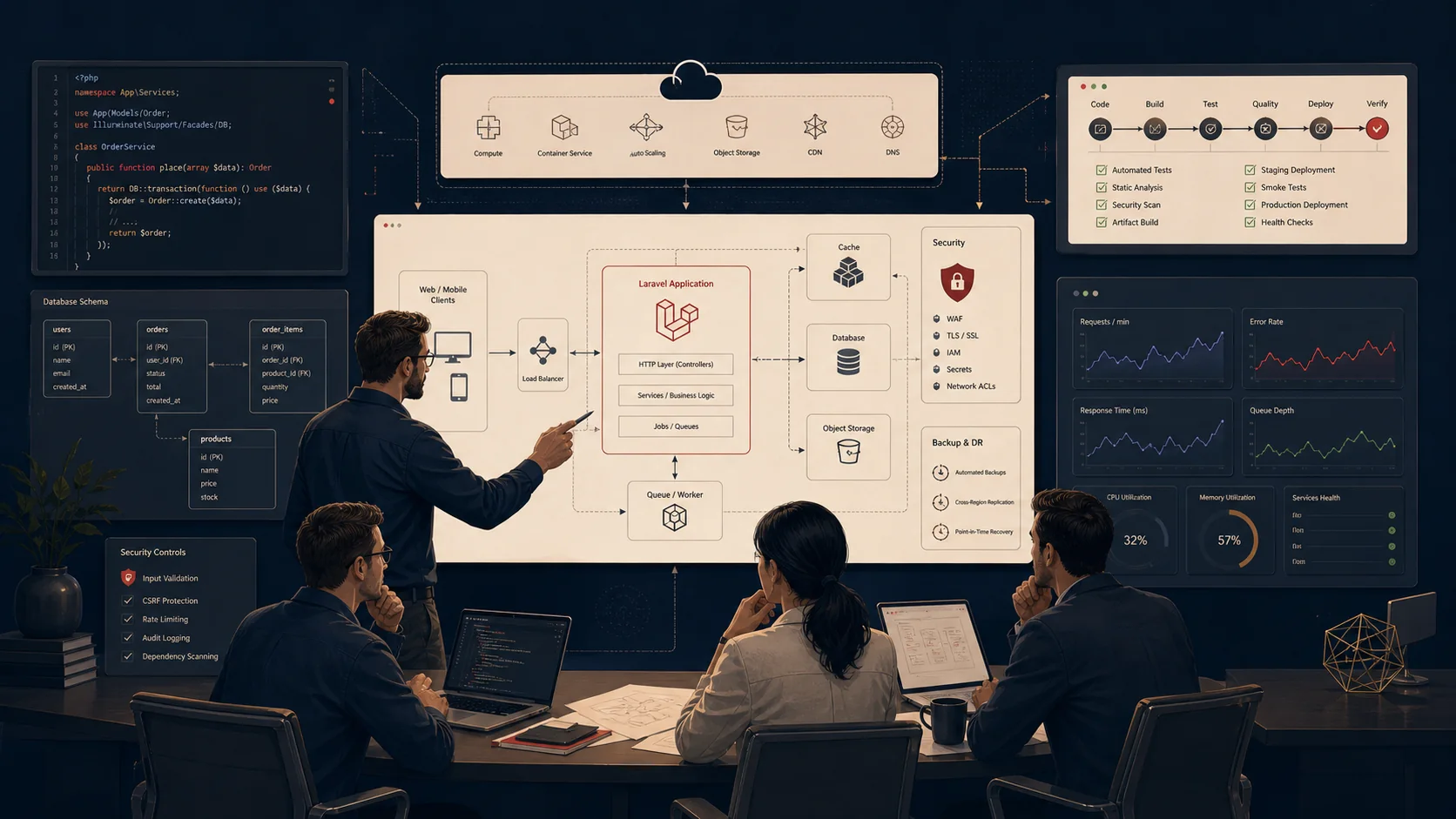
The most useful technical interview follows one important workflow from the browser to the database, external providers, infrastructure, and operational evidence. Ask how the company would implement it, how it could fail, and how the team would know.
Existing Laravel maintenance and modernization
An inherited application should begin with an audit: supported PHP and Laravel versions, Composer dependencies, routes, authentication, authorization, schema, test coverage, storage, integrations, deployment, logs, and known incidents. The first recommendation should distinguish urgent risk from stylistic preference. An automatic rewrite wastes working knowledge unless evidence shows incremental improvement is less safe or more expensive. Our Laravel maintenance guide explains what responsible ongoing care includes.
Legacy PHP to Laravel migration
Legacy modernization requires archaeology as well as design. Business rules may live in SQL, cron scripts, templates, exports, or undocumented operator habits. Strong teams use characterization tests, staged boundaries, reconciliation, data validation, compatible releases, and rollback planning. They preserve valuable behavior while replacing risk in controlled increments. Review the practical legacy PHP to Laravel migration approach and the guide to upgrading legacy PHP applications safely.
APIs and third-party integrations
A demo proves only the happy path. Production integration work must address secret storage, authentication refresh, timeouts, retry policy, exponential backoff, rate limits, pagination, webhook signature verification, duplicate delivery, ordering, idempotency, reconciliation, sandbox differences, and provider-version changes. Ask for a real example of a partial failure and how the system repaired consistency without double-charging or losing data.
Database architecture and performance
Eloquent convenience does not replace relational design. Candidates should discuss constraints, indexes, query plans, eager loading, transaction isolation, concurrency, locking, retention, backup restoration, and safe changes to populated tables. Ask how a large column change or backfill would be released without holding a table lock or leaving old application instances incompatible. Performance work should begin with traces and query evidence; our PHP performance bottleneck guide shows that diagnostic mindset.
Queues, jobs, caching, Redis, and background processing
Background processing is useful for slow, retryable work, but it introduces a second execution model. A strong design defines idempotency keys, retry limits, timeouts, backoff, poison-message handling, failure visibility, and what happens when work completes out of order. Caching requires ownership of invalidation, TTLs, stale-data tolerance, key design, and fallback behavior. Redis should solve a measured coordination or performance problem, not appear because it sounds scalable. The operating model must match the deployment: some environments use supervised workers, while self-contained systems may use application-driven events, webhooks, or controlled detached processes.
AWS infrastructure and cloud deployment
AWS experience should connect application requirements to compute, networking, managed databases, object storage, DNS, certificates, secrets, IAM, backups, logs, availability, recovery, and cost. Ask for a diagram of the proposed request path and trust boundaries. The answer should explain why each managed service exists and who operates it. More services do not automatically create more reliability. See the CPD AWS and Laravel DevOps service for the concerns surrounding production code.
Docker and environment consistency
Docker can make PHP extensions, system packages, and supporting services reproducible across development and CI. It does not guarantee production parity by itself. Compare runtime versions, configuration, filesystem behavior, architecture, build artifacts, and service dependencies. Ask how developers receive representative data safely and how environment drift is detected.
CI/CD, tests, and production reliability
A delivery pipeline should build a known artifact, run relevant tests and analysis, protect secrets, apply compatible database changes, deploy predictably, verify health, and retain evidence. Rollback may mean restoring the previous artifact or shipping a forward fix; destructive database changes often cannot simply be reversed. Ask which critical workflows have feature or integration tests and which release risks require manual checks. The AWS and CI/CD guide provides a deeper release model.
Security and authorization
“Laravel is secure” is not a security plan. The framework supplies useful controls, but developers still define who can view or change each record. Evaluate server-side policies, tenant isolation, validation, mass-assignment rules, file handling, output escaping, CSRF protection, rate limiting, session behavior, dependency updates, secret management, encryption, least-privilege cloud access, audit evidence, and sensitive log handling. Ask candidates to identify the highest-impact abuse cases in your proposed workflow.
Monitoring, logging, rollback, and incident readiness
Production support starts before launch. Applications need structured logs, exception reporting, request or correlation identifiers, health checks, service and database metrics, meaningful alerts, backup verification, runbooks, and clear escalation ownership. Ask a candidate to narrate an incident: signal, triage, mitigation, data verification, communication, root cause, and the change that prevented recurrence. Specific operational stories are difficult to fake.
AI-Assisted Laravel Development Still Needs Engineering Oversight
AI coding tools can accelerate codebase research, scaffolding, test cases, documentation, migrations, and repetitive implementation. They can also invent APIs, miss an authorization boundary, copy an outdated package pattern, or produce code that passes a superficial review while mishandling concurrency.
The useful question is not whether a company uses AI. Ask how generated changes are constrained, reviewed, tested, and traced. Senior engineers must remain accountable for architecture, data safety, package selection, security, integration contracts, release decisions, and production results. Our article on why AI still needs experienced software developers examines that boundary, while our Laravel and ChatGPT integration guide shows what that responsibility looks like in an actual application architecture.
How to Evaluate a Portfolio and Technical Experience
A screenshot portfolio shows interface taste, not engineering depth. Choose two relevant projects and ask what the company actually owned. Was it architecture, backend code, database design, infrastructure, or a narrow frontend feature? Which engineers performed the work? What scale, data sensitivity, integrations, and availability requirements existed?
Ask for a before-and-after story with constraints: a slow query found through evidence, a risky deployment made repeatable, a legacy module replaced incrementally, or an integration reconciled after partial failure. Confidentiality may limit code or client names, but it should not prevent a clear technical narrative. Verify that the senior people in the sales process will review or perform the work.
Relevant experience is contextual. For a SaaS product, prioritize tenant isolation, billing state, permissions, onboarding, and operability. For modernization, prioritize codebase discovery, data preservation, compatible releases, and restraint. For integration-heavy software, prioritize idempotency, reconciliation, observability, and vendor failure handling.
Freelancer vs Agency vs Senior-Led Laravel Development Company
| Model | Typical cost | Availability and continuity | Breadth and scalability | Best fit |
|---|---|---|---|---|
| Freelancer | Often lower overhead; specialist rates vary | Direct access, but capacity and absence may create a single-person dependency | Deep in selected areas; may need outside infrastructure, design, or QA support | Bounded features, audits, maintenance, or direct access to a proven specialist |
| Laravel agency | More overhead, with several disciplines potentially included | Broader coverage, though communication may pass through account or project roles | Can add design, frontend, QA, and delivery capacity as scope changes | Multi-discipline projects that need coordinated delivery and schedule coverage |
| Senior-led development company | Usually reflects senior engineering and production responsibility | Direct technical communication with documented handoff and review coverage | Strong application and infrastructure range; capacity should be verified | Custom applications, SaaS, modernization, integrations, and business-critical systems |
No label guarantees quality. A senior freelancer may outperform a large agency; a disciplined agency may provide continuity one person cannot. Compare the people assigned, decision authority, review coverage, response expectations, and exit plan. The guide to alternatives for hiring PHP developers offers more detail on engagement models.
How Scope and Risk Affect Laravel Development Cost
Scope is more than a feature count. Cost changes with the number of user roles, workflow exceptions, integrations, data volume and quality, migration requirements, security exposure, interface complexity, availability expectations, infrastructure, testing depth, documentation, and support. Unknown legacy behavior and vendor dependencies add discovery risk even when the visible interface looks small.
A low hourly rate can create a high total project cost when work requires more hours, rework, management, production repair, or later replacement. Compare proposals using total cost of ownership: discovery, implementation, internal oversight, hosting, launch, defects, downtime, maintenance, upgrades, documentation, and switching cost. A higher-rate engineer who prevents a flawed data model or fragile integration may be materially cheaper.
Responsible estimates are usually phased. A short discovery or technical audit reduces uncertainty; a prioritized release creates useful value; later phases respond to evidence. Ask what is excluded, which assumptions drive the range, who absorbs rework caused by defects, and how changes are approved. For realistic factors and ranges, read how much Laravel development costs in 2026 and how project scope affects the development timeline.
Questions to Ask Before Hiring
- Who will architect, implement, review, deploy, and support the application? Will those people join the evaluation?
- Show us how one relevant production system handles authorization, data changes, integrations, releases, and incidents.
- How do you audit an existing Laravel or legacy PHP application before recommending changes?
- How do you release a backward-compatible database migration on a populated production table?
- How do you prevent duplicate API or webhook events from producing duplicate business actions?
- Which automated tests will protect our most expensive failure modes?
- What happens from commit through staging, production verification, rollback, and post-release monitoring?
- Which AWS accounts, repositories, domains, credentials, analytics, and vendor accounts will our company control?
- How are architectural decisions, setup, deployments, integrations, and recovery procedures documented?
- What are support hours, response targets, severity definitions, escalation paths, and after-hours boundaries?
- How do you use AI tools, and what human review is required before generated code reaches production?
- What assumptions could change the estimate, and what will the first phase do to validate them?
Warning Signs and Red Flags
- A proposal gives a fixed architecture and exact estimate before anyone examines requirements, data, or the current codebase.
- The portfolio emphasizes screenshots but the team cannot explain production responsibilities or failures.
- Sales presents senior engineers who disappear after the contract is signed.
- The team edits production directly, lacks reviewable Git history, or cannot explain release recovery.
- Database constraints, migrations, backups, restoration, and data reconciliation are treated as hosting details.
- Security is reduced to framework defaults or a scanner, with no discussion of record-level authorization.
- Every inherited system is declared a rewrite before an audit.
- Queues, Redis, microservices, Kubernetes, or AI are proposed without a measured requirement and operating plan.
- The client cannot access the repository, cloud accounts, domains, or third-party services.
- There is no defined post-launch owner, documentation, monitoring, or transition path.
Practical Checklist for Choosing a Laravel Development Partner
Score each finalist from 1 to 5 and record the evidence behind each score. Mark unanswered items unknown. Do not let a strong average compensate for unacceptable data ownership, security, or continuity terms.
| Area | Evidence to obtain |
|---|---|
| Relevant delivery | Two comparable projects, named responsibilities, assigned people, and production outcomes |
| Architecture | Workflow boundaries, permissions, authoritative data, tradeoffs, and expensive-to-reverse decisions |
| Data | Schema and index reasoning, transaction strategy, safe migrations, backups, and restoration verification |
| Integrations | Timeout, retry, idempotency, webhook, rate-limit, reconciliation, and observability examples |
| Delivery | Review process, automated checks, artifacts, staging, deployment, health verification, and recovery |
| Security | Authorization design, tenant isolation, secrets, dependency care, least privilege, and audit evidence |
| Operations | Logs, metrics, alerts, incident ownership, runbooks, backup testing, and response expectations |
| Maintainability | Conventions, tests, dependency strategy, documentation, upgrade plan, and knowledge transfer |
| Commercial fit | Assumptions, exclusions, phased estimate, change control, IP terms, account ownership, and exit plan |
| Communication | Named lead, meeting rhythm, demonstrations, decision records, risk reporting, and escalation route |
For finalists, use a paid discovery sprint, architecture review, or small production-representative milestone. The output should remain useful even if you do not continue: findings, risks, decisions, priorities, and a credible delivery range. That is a better test than asking for unpaid speculative designs.
Evaluate Long-Term Support and Maintainability
The application will outlive the launch plan. Confirm who owns dependency and framework upgrades, security updates, backups, certificates, cloud costs, monitoring, incidents, and incremental improvements. Define what counts as maintenance versus new development, response expectations by severity, and what happens when the primary engineer is unavailable.
Maintainability should be visible in the repository and operating model: consistent conventions, tests around business risk, small reviewable changes, useful documentation, reproducible environments, controlled access, and client-owned accounts. Require a transition path with setup instructions, architecture decisions, integration notes, deployment and recovery procedures, and current credentials stored in an appropriate secret system.
Frequently Asked Questions
How do I choose the best Laravel development company?
Define the risks and outcomes of your application, then compare relevant production evidence. The best fit can explain architecture, data, delivery, security, operations, cost assumptions, and long-term ownership in the context of your project.
What does a Laravel development company do?
It designs, builds, integrates, tests, deploys, maintains, and modernizes Laravel applications. A production-capable partner also handles the database, infrastructure, security, observability, releases, and recovery within an agreed scope.
When should I hire a Laravel specialist instead of a web agency?
Use a specialist when custom workflows, permissions, SaaS behavior, integrations, legacy code, important data, performance, or production reliability drive the project. Use a general agency when content, branding, and conventional site delivery are primary.
How can I find a Laravel development company for custom applications?
Shortlist teams with relevant application—not only website—experience. Interview the people assigned to the work, verify production responsibilities, apply a consistent scorecard, and begin with a paid audit or milestone that exposes technical judgment.
Can a Laravel company improve an existing application without rewriting it?
Yes. A careful team can audit the system, add characterization tests, upgrade dependencies, isolate risky modules, improve releases, and modernize incrementally. Rewriting is one option, not the automatic answer.
How much does a Laravel development company cost?
Cost follows workflow complexity, unknowns, integrations, data, security, infrastructure, testing, and support. Compare total ownership cost and risk, not the hourly rate by itself.
Should a Laravel company use AI-assisted development?
AI can accelerate well-governed work. Require experienced human review of architecture, authorization, data behavior, dependencies, tests, and releases, with clear accountability for production outcomes.
Who should own the Laravel source code?
The contract should clearly assign ownership, and the client should have access to the Git repository, source code, cloud accounts, domains, credentials, and documentation needed to operate or transfer the application.
A Better Definition of “Best”
The best Laravel development company is not the vendor with the loudest claim. It is the partner whose experience fits the application, whose reasoning remains clear under scrutiny, and whose process reduces the business’s most expensive risks. It may recommend a simpler platform, a smaller first phase, or an incremental repair instead of the largest possible build.
Custom PHP Design provides senior-led Laravel application development, custom PHP development, modernization, integrations, AI features, AWS deployment, Docker and CI/CD, performance work, and ongoing Laravel consulting. Developer-led technical SEO services are also available when routes, rendering, performance, or application code affect organic visibility. We do not ask buyers to accept a “best” label. Bring the workflow, codebase, constraints, and risks; the useful first step is an honest technical plan with clear ownership.