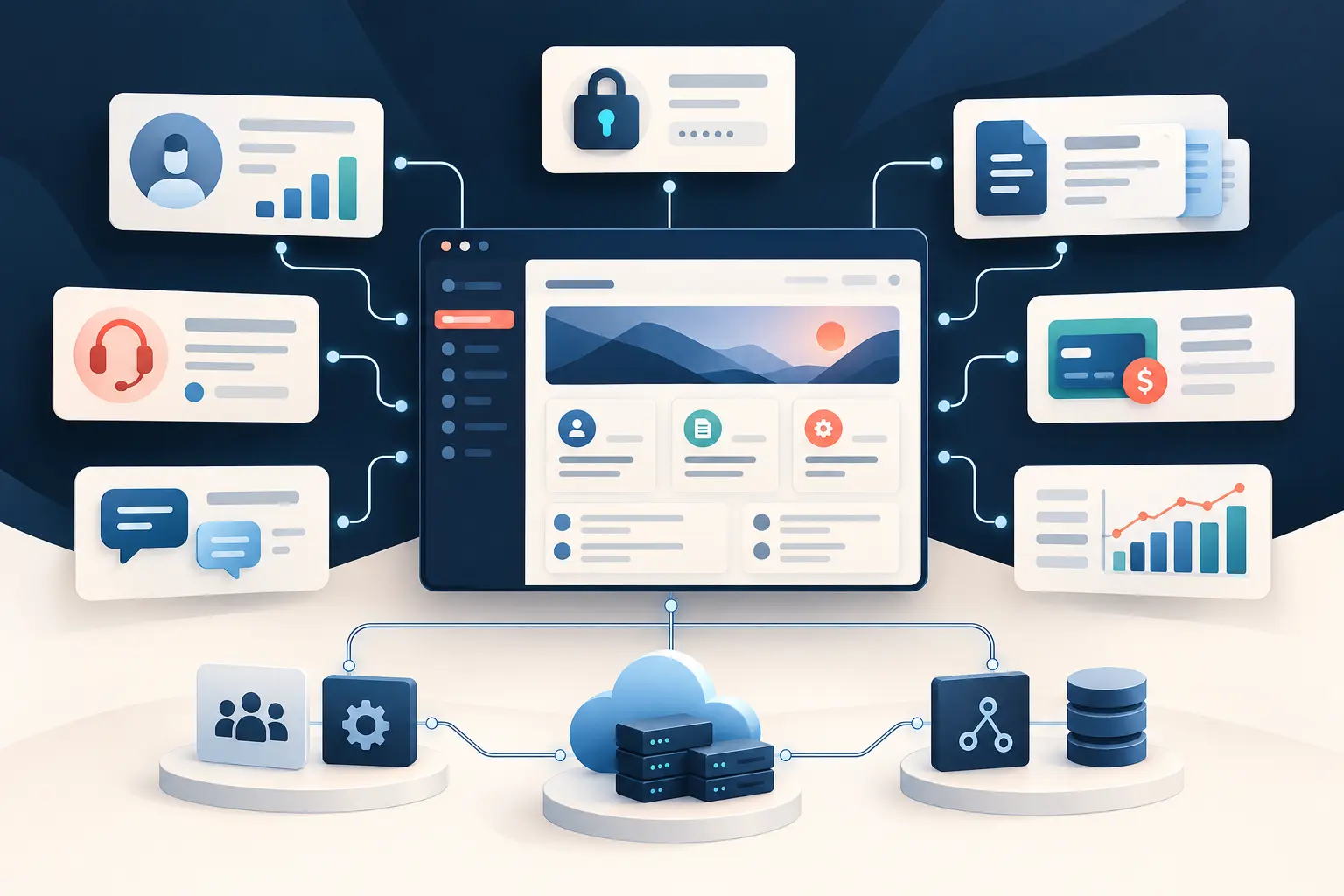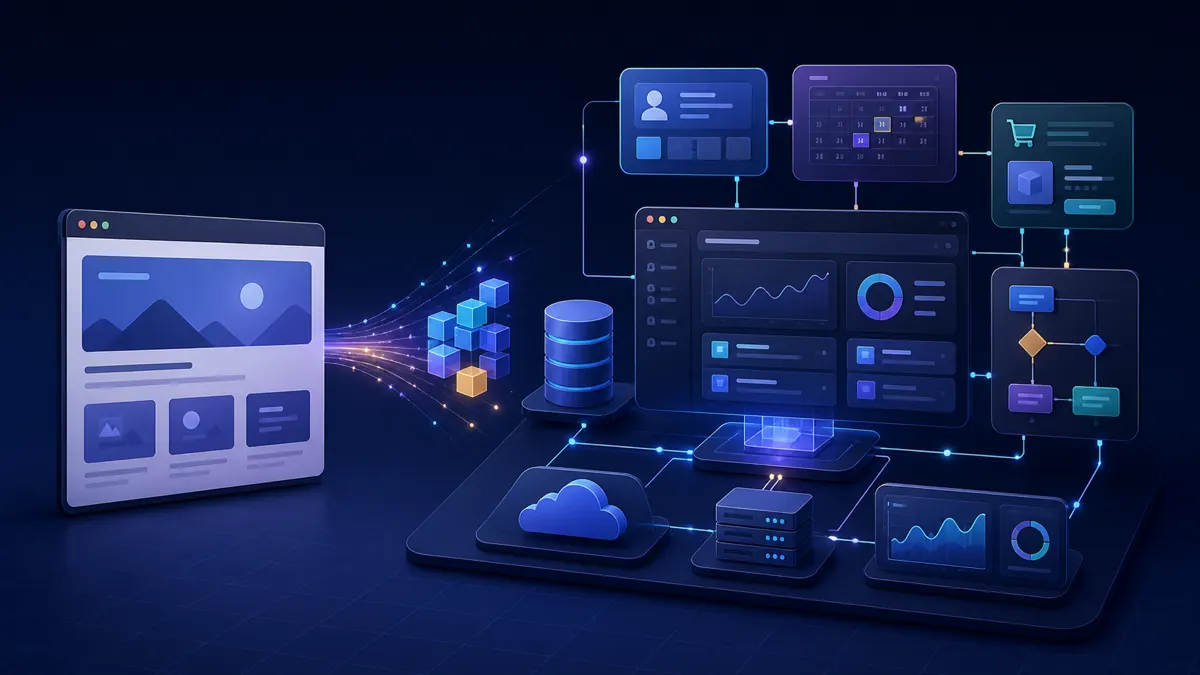
Custom Laravel web development becomes relevant when a business needs the web to do more than explain services and collect a contact form. The application may need to identify customers, enforce permissions, coordinate work, connect outside systems, calculate prices, accept bookings, expose live status, or preserve an audit trail. At that point, the project is no longer simply a website with extra pages. It is business software delivered through a browser.
That distinction matters to buyers. A conventional site can be excellent at publishing content, building trust, and generating leads. A custom application is expected to perform operations reliably with real users, sensitive data, external providers, and consequences when something fails. The design conversation therefore moves from page layouts to workflows, database integrity, authorization, integrations, deployment, monitoring, and long-term ownership.
This guide is for business owners, founders, operations leaders, and technical decision-makers considering a new application, a modernization project, or a replacement for spreadsheets and disconnected tools. It focuses on the commercial question behind custom Laravel web development: what should be built, when is custom software justified, and what does professional delivery require?
Custom Laravel Web Development Goes Beyond a Business Website
An ordinary business website is primarily a communication system. Visitors read service pages, compare expertise, view work, submit a form, or make a straightforward purchase. Content management, search visibility, analytics, performance, accessibility, and conversion design matter greatly, but most visitors see substantially the same information.
A custom Laravel web application is an operating system for a particular part of the business. Its response changes according to the signed-in person, their organization, their permissions, the state of a record, and events from other systems. A customer might upload a document and see an order move into review. An employee might approve an exception. A partner API might update fulfillment status. Each action can change data, trigger notifications, create follow-up work, and become part of a traceable history.
| Business concern | Ordinary website | Custom Laravel web application |
|---|---|---|
| Primary purpose | Publish, persuade, and generate inquiries | Execute a product or operational workflow |
| Users | Mostly anonymous visitors and content editors | Customers, staff, partners, administrators, and systems |
| Data | Pages, media, forms, and basic orders | Business records, state changes, relationships, history, and reporting |
| Permissions | Usually simple editor roles | Record-level authorization based on role, ownership, organization, or state |
| Integrations | Analytics, email forms, and common plugins | Operational APIs, webhooks, payments, accounting, CRM, logistics, and AI |
| Failure impact | A lost inquiry or unavailable page | Interrupted operations, incorrect data, delayed orders, or customer impact |
| Delivery responsibility | Design, content, hosting, and maintenance | Architecture, security, testing, releases, monitoring, recovery, and evolution |
A project can contain both. Laravel may power a public marketing experience and a secure application behind it, or WordPress may manage public content while Laravel owns customer operations. The right boundary follows the job each system performs. Our comparison of Laravel web design and application development explores that decision in more detail.
Business Applications Built With Laravel
Laravel application development is flexible enough to support a focused internal tool or an application used by thousands of customers. The useful question is not whether Laravel can produce a particular screen. It is whether the team can model the workflow, data, security, integrations, and operating load behind it.
Customer and partner portals
A portal can give customers secure access to orders, documents, requests, invoices, account settings, approvals, and real-time status. It can reduce support calls while giving staff one accountable record of what the customer submitted and what happened next. Partner portals can apply different permissions, pricing, inventory views, or approval rules to each organization.
Internal business systems and dashboards
An internal Laravel application can replace scattered admin panels with one role-aware workspace. Staff can manage cases, review exceptions, assign work, search records, generate documents, and view dashboards whose metrics trace back to authoritative data. A dashboard is most valuable when it leads to action, not when it merely redraws numbers from a spreadsheet.
SaaS applications
Laravel can support a software product with organizations, teams, invitations, roles, plans, subscriptions, billing events, usage controls, administration, notifications, APIs, and tenant-aware data. The difficult work lies in product rules: who owns an account, how access changes after billing events, how tenant data is isolated, and how support access is audited.
Booking and scheduling systems
A custom booking system becomes useful when availability depends on capacity, location, staff skills, equipment, service duration, lead time, pricing, deposits, or approval. The application can coordinate availability, reminders, cancellations, external calendars, and operational follow-up without forcing the business into a generic appointment model.
Workflow automation and spreadsheet replacement
Many projects begin with a spreadsheet, an inbox, and employees who know the unwritten rules. A Laravel application can turn that process into validated intake, assignments, approvals, reminders, exception states, audit history, and reporting. The goal is not to recreate every cell. It is to establish authoritative records and remove fragile handoffs. The recent guide to custom PHP business automation explains how to quantify that opportunity.
API integrations and connected operations
Custom applications can coordinate CRMs, accounting platforms, payment processors, shipping services, social APIs, email providers, cloud services, AI providers, and older internal systems. That can be better than replacing every established tool. Laravel becomes the controlled workflow between them, with validation, timeouts, webhook verification, idempotency, reconciliation, and useful failure records.
Ecommerce systems with specialized rules
Shopify is excellent for conventional catalog commerce. Custom Laravel ecommerce makes sense when products, quotes, configuration, entitlements, fulfillment, customer-specific pricing, or post-purchase operations are genuinely distinctive. Even then, a hybrid may retain a proven payment or fulfillment provider while Laravel owns the business-specific experience.
Why Laravel Works Well for Custom Business Applications
Laravel is useful because it supplies a coherent, well-supported foundation for common application concerns. Experienced teams can spend more time on the rules that make the business different and less time inventing basic framework infrastructure. That does not make good architecture automatic, but it creates productive conventions.
Authentication and authorization
Authentication establishes identity; authorization decides what that identity may do. Laravel supports sessions, password security, email verification, API authentication, gates, and policies. A production application can express rules such as “account managers may edit only customers assigned to their organization” and enforce them on the server, not merely hide a button.
Databases and data integrity
Eloquent, migrations, validation, transactions, and relational database support give teams a consistent way to model business records. Professional database design still requires explicit relationships, unique constraints, indexes, lifecycle states, retention rules, and safe production changes. The database is often where the application’s promises become enforceable.
Queues, scheduled work, and notifications
Laravel provides abstractions for work that should not block an interactive request, recurring operations, and notifications through channels such as email. The execution model must fit the deployment. Some environments operate monitored queue workers and scheduler triggers; a self-contained application can instead start bounded detached processes from authenticated actions, react to webhooks, or use an external trigger. In every model, delayed work needs idempotency, timeouts, failure visibility, and recovery.
APIs and integrations
Routing, validation, API resources, authentication, rate limiting, HTTP clients, events, and test tools help Laravel serve web or mobile clients and communicate with other platforms. The framework provides mechanics; developers remain responsible for stable contracts, protected credentials, retries, duplicate events, provider outages, and reconciliation.
Testing, maintainability, and scale
Laravel supports unit and feature tests around requests, policies, databases, jobs, events, notifications, and APIs. Tests give teams confidence to change important software, especially when they protect permissions, money, tenant isolation, data integrity, and integration behavior. Clear conventions also make the codebase easier for another qualified developer to understand.
Scalability begins with efficient queries, indexes, pagination, caching policy, right-sized infrastructure, and measurement. When evidence requires it, Laravel can run across multiple application instances, use object storage and managed databases, coordinate background processing, and place static assets behind a CDN. A maintainable modular application is usually a safer beginning than premature distributed complexity.
When Custom Development Is—and Is Not—the Right Investment
Custom software carries opportunity and responsibility. The business funds discovery, design, engineering, hosting, security updates, monitoring, maintenance, and future changes. It should solve a sufficiently valuable problem, not simply satisfy a preference for owning code.
Use WordPress when content is the main product
WordPress can be the better choice for a marketing site, publication, brochure site, or content operation whose needs fit mature themes and plugins. It offers a familiar editor and a large ecosystem. A custom application becomes easier to justify when the central requirement is a proprietary workflow, complex record-level permissions, or operational data—not because WordPress is incapable of displaying a custom page.
Use Shopify when commerce follows a proven model
Shopify can provide storefront, catalog, checkout, payment, tax, and ecosystem capabilities far faster than rebuilding standard retail commerce. Choose custom engineering only where specialized configuration, quoting, fulfillment, entitlement, marketplace, or integration behavior creates enough business value to support it.
Use off-the-shelf SaaS when the workflow is common
A CRM, help desk, accounting system, scheduling product, or project-management platform is often the economical answer when the organization can adopt its workflow. The vendor spreads development and security costs across customers. Custom software deserves consideration when subscription growth, manual reconciliation, duplicated data, poor integration, or forced workarounds have become a measurable constraint.
A hybrid is frequently best: keep the reliable SaaS product as a system of record and use Laravel to coordinate the proprietary portion. Before commissioning custom Laravel development services, identify the recurring problem, current cost, expected benefit, accountable owner, and smallest release capable of proving value.
The Complete Laravel Web Development Lifecycle
Professional Laravel web development includes far more than implementation. Each stage reduces a different kind of business or technical uncertainty. Our detailed Laravel development process guide expands on this lifecycle.
1. Discovery and requirements
Discovery maps users, current workflows, pain points, business rules, exceptions, systems, data ownership, risks, and success measures. Requirements should describe observable outcomes and acceptance conditions. “Add approvals” becomes a defined rule covering who submits, who approves, thresholds, delegation, audit history, notifications, and failure states.
2. Architecture and database design
Architecture selects application boundaries, interface approach, identity model, permissions, integration contracts, deployment shape, and failure behavior. Database design defines entities, relationships, constraints, indexes, history, retention, and migration strategy. A modular monolith is often a practical starting point: clear internal boundaries with one understandable deployment.
3. Incremental development
Implementation should deliver small vertical slices that include interface, validation, authorization, business behavior, persistence, error handling, and tests. Reviewable Git changes and visible milestones make progress easier to verify. A focused first release should complete one valuable workflow instead of spreading effort across unfinished modules.
4. Integrations and data migration
Third-party APIs need credential management, sandbox validation, timeouts, signatures, rate limits, idempotency, retries where safe, logs, and reconciliation. Existing data needs profiling, mapping, cleanup, rehearsed imports, count and checksum verification, and a cutover plan. These are core deliverables, not launch-week details.
5. Testing and security review
Testing should cover critical user journeys, policies, business rules, data integrity, APIs, provider failures, and responsive interfaces. Security review considers server-side authorization, input validation, uploads, secrets, sensitive logs, dependency risk, least-privilege cloud access, backups, and abuse cases. The highest-risk behavior receives the strongest verification.
6. Deployment, monitoring, and recovery
CI/CD can run checks, build a known artifact, apply compatible changes, deploy consistently, and verify application health. AWS infrastructure may include right-sized compute, managed databases, object storage, protected secrets, logs, metrics, backups, and recovery procedures. Monitoring should cover errors, latency, slow queries, external dependencies, storage, resource pressure, and business operations that did not complete.
7. Maintenance and future feature development
Launch begins the operating lifecycle. The team responds to evidence, supports users, applies security and dependency updates, tests recovery, manages provider changes, improves performance, and prioritizes new features. Documentation and clear ownership reduce dependence on individual memory. For planning expectations, compare the guides to Laravel development cost and realistic application timelines.
AI-Assisted Laravel Development Without Giving Up Engineering Responsibility
AI can accelerate repetitive and well-bounded development work. An experienced developer can use it to draft validation, tests, API clients, migrations, documentation, troubleshooting hypotheses, refactoring options, and routine interface code. It can help search a codebase, explain an unfamiliar path, compare logs with recent changes, and produce a starting point that would otherwise require more manual typing.
The productivity gain is real, but generated code is not proof of correctness. AI does not own the production consequences and may miss an undocumented business rule, weaken an authorization boundary, invent a provider capability, or produce a plausible test that verifies the wrong behavior. Speed only creates value when review and verification keep pace.
Experienced developers remain responsible for architecture, security, database integrity, business requirements, code review, deployment, monitoring, and recovery. They decide what context can be shared with a model, inspect the change in the surrounding system, run the relevant tests, and reject output that does not fit established patterns. AI-assisted custom Laravel web application development should make accountable engineering faster, not remove accountability.
Choosing a Laravel Development Partner
A capable Laravel development company should ask about the business process before prescribing features. It should be able to explain database decisions, permissions, external failure handling, deployment, monitoring, and ownership in language stakeholders can evaluate. Relevant experience includes taking over existing applications and delivering focused improvements—not only greenfield builds.
Ask who performs discovery, reviews code, owns AWS and CI/CD, responds to a failed release, monitors integrations, and maintains the application after launch. Confirm repository and infrastructure access, documentation, third-party licenses, data export paths, and how another qualified team could take over. The guide to evaluating a Laravel development partner provides a practical checklist.
Also distinguish framework familiarity from production capability. Strong custom PHP development experience helps when a project includes legacy code, low-level integrations, performance constraints, or behavior outside the happy path. Laravel expertise should sit on top of sound PHP, SQL, HTTP, security, and operational judgment.
Custom Laravel Web Development With Custom PHP Design
Custom PHP Design builds, modernizes, and maintains production-ready business applications. Our Laravel application development services cover discovery, architecture, databases, portals, SaaS products, workflow automation, APIs, ecommerce, testing, deployment, and continued feature development. We work across the application and the production environment so delivery decisions account for how the system will actually operate.
That includes long-term maintainability, AWS infrastructure, CI/CD, monitoring, integrations, legacy PHP modernization, and careful ownership of live systems. The objective is not maximum customization. It is the smallest durable application that solves the right business problem and provides a foundation for responsible growth.
Frequently Asked Questions
What is custom Laravel web development?
It is the design, construction, deployment, and maintenance of a Laravel web application around a business’s specific users, workflows, data, permissions, integrations, and operating requirements.
What is the difference between a website and a Laravel web application?
A website primarily publishes information and generates inquiries. A web application identifies users, changes business data, enforces rules, coordinates workflows, integrates systems, and supports ongoing operations.
When should a business choose custom Laravel development?
Evaluate it when a valuable workflow cannot be supported cleanly by packaged software, disconnected systems create recurring cost or risk, or customers and staff need one secure application around proprietary data and rules.
When are WordPress, Shopify, or SaaS products better?
They are often better when requirements are common, standard workflows are acceptable, and launching quickly matters more than owning specialized behavior. Custom development is not automatically the superior choice.
Can AI build a production Laravel application?
AI can accelerate implementation, tests, debugging, documentation, and repetitive work. Experienced developers must still own requirements, architecture, security, review, deployment, monitoring, and production reliability.
What happens after a custom Laravel application launches?
The team monitors application and business behavior, supports users, manages security and dependencies, verifies backups and recovery, responds to provider changes, and delivers future features through controlled releases.
Build the Application Your Business Actually Needs
Custom Laravel web development is most valuable when it converts a meaningful operational constraint or product opportunity into secure, maintainable software. The decision should begin with the workflow and economics, not an assumption that every business needs custom code. When the fit is right, Laravel provides a productive foundation for applications that can evolve with the organization.
If you are planning a customer portal, internal platform, SaaS product, workflow system, integration project, modernization, or application takeover, Custom PHP Design can help define a sensible first phase and carry it into production.