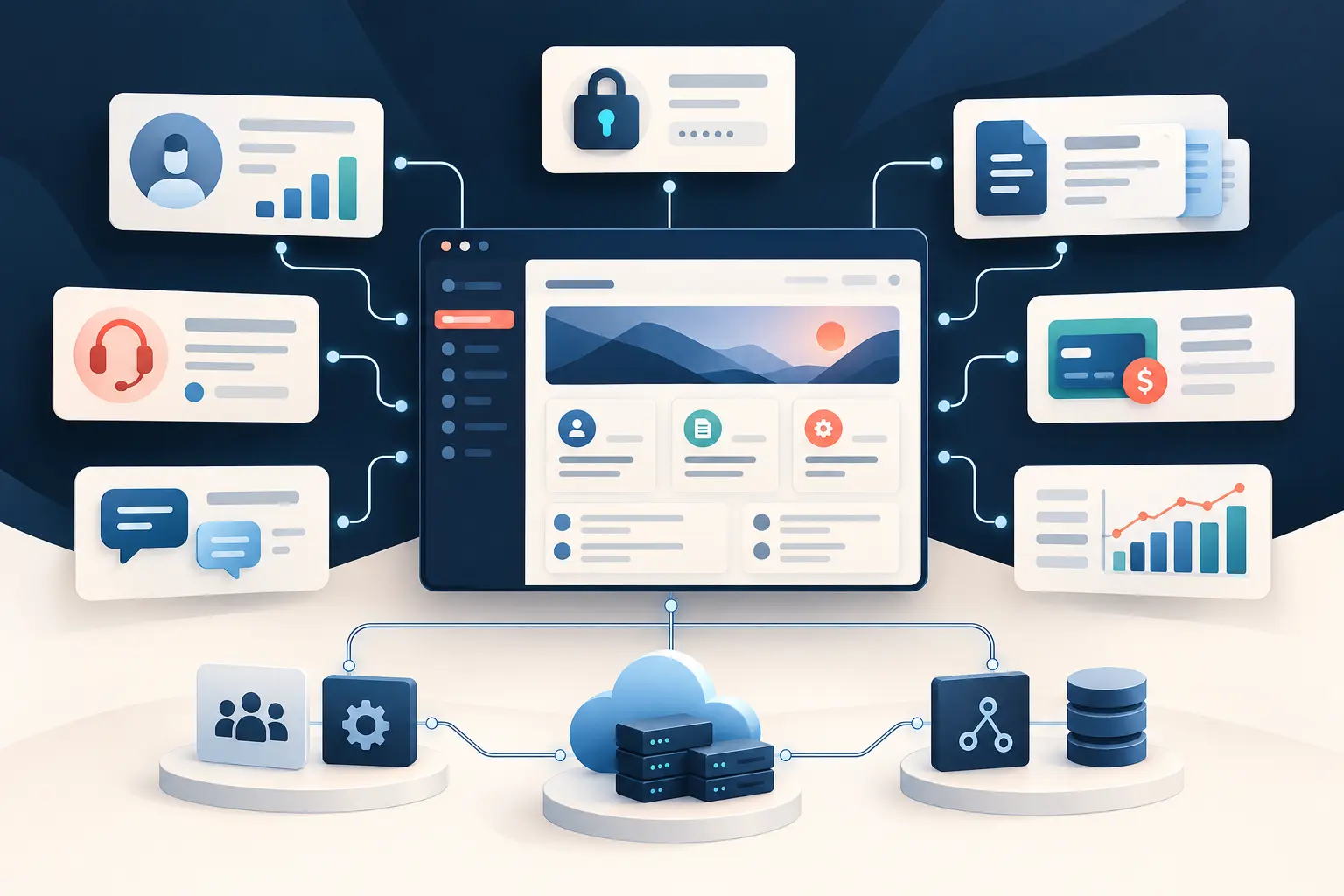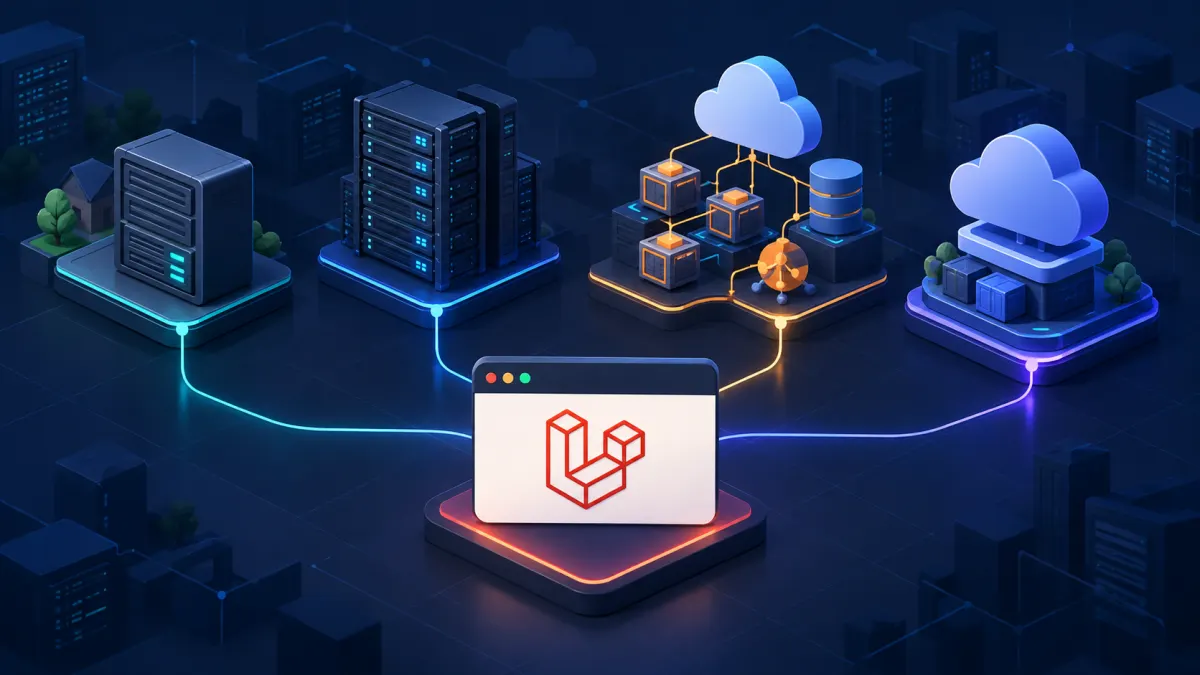
Custom Laravel development services give a business more than programmers who can write PHP. A capable partner helps define the problem, design the application and database, build the right workflows, connect external systems, release safely, observe production behavior, and maintain the software after launch.
What the business is buying is accountable delivery across the application lifecycle. That may mean a new customer portal, a SaaS product, a difficult API integration, or a staged modernization of an application that already carries years of business rules. The scope should connect each technical activity to a measurable business outcome and leave the client with durable ownership of its code, accounts, data, and operational knowledge.
Direct answer: what should custom Laravel development include?
A complete engagement can include discovery, requirements, architecture, user and permission design, database engineering, application development, APIs, third-party integrations, legacy modernization, AWS or cloud deployment, automated testing, security review, performance work, monitoring, documentation, maintenance, and long-term product development. Not every project needs every item, but responsibilities should be explicit.
The practical test is whether the provider owns the path from business requirement to dependable production behavior. A narrow coding quote may exclude data cleanup, integration failures, deployment, monitoring, or handoff—the work that often determines whether the application succeeds. CPD’s broader Laravel development services capability guide explains the individual disciplines; this article focuses on how a buyer should assemble and evaluate them as one engagement.
Start with discovery, not a premature feature estimate
Discovery identifies who uses the software, what they are trying to accomplish, where the authoritative data lives, which exceptions create cost, and what must remain true during change. For an existing system, it also examines the repository, framework and PHP versions, packages, schema, deployment, logs, incidents, tests, hosting, and undocumented business behavior.
Useful outputs may include a workflow map, prioritized requirements, user roles, system inventory, integration list, architecture decisions, risks, acceptance criteria, and a staged release plan. Discovery does not need to become months of documents. Its purpose is to turn expensive unknowns into visible decisions and identify the smallest release that creates real value.
A responsible Laravel consultant may recommend a packaged product, a focused integration, or stabilization before new features. The framework is a means, not the business outcome. Our Laravel consulting guide explains where advisory work ends and implementation begins.
Architecture should reflect the business and its operating model
Architecture defines boundaries that become costly to change: accounts and organizations, permissions, data ownership, integrations, audit history, background work, deployment, and recovery. A strong design is not the most elaborate design. It is the simplest structure that protects current requirements while leaving credible room for expected growth.
Laravel provides mature conventions for routing, validation, authorization, database access, caching, notifications, APIs, and testing. Custom value comes from the policies, workflows, data model, interfaces, and integrations built around one organization. Read when custom Laravel development makes business sense for the build-versus-buy decision rather than the vendor-scope decision covered here.
Architecture must also respect the deployment environment. A design should not depend on workers, scheduled processes, or cloud products the organization cannot reliably operate. Operational simplicity is a feature when it reduces failure modes and handoff cost.
Application development should deliver complete business slices
Custom Laravel web development can produce customer portals, internal operations systems, SaaS platforms, quoting and scheduling tools, inventory workflows, approval systems, reporting applications, subscription products, and integration hubs. The most useful delivery unit is a complete workflow a real user can verify—not a pile of disconnected screens or backend classes.
For example, “customer onboarding” may include an invitation, identity verification, role-based access, validation, a saved record, notifications, an audit event, administrator visibility, tests, and production monitoring. Delivering that vertical slice exposes misunderstandings earlier and gives stakeholders evidence of progress.
A healthy implementation follows the application’s existing conventions, keeps controllers focused, centralizes important business rules, and avoids speculative abstractions. Reviewable changes, clear acceptance criteria, and frequent demonstrations make the work easier to steer than a long build followed by a single reveal.
Database engineering is part of the product
The database often survives several interfaces and development teams. Laravel application development services should deliberately address entities, relationships, constraints, indexes, transaction boundaries, retention, imports, exports, and migration safety. Eloquent improves developer productivity, but it cannot decide which records are authoritative or which states should be impossible.
Existing data deserves special care. Duplicate identifiers, inconsistent formats, missing relationships, and undocumented reporting rules can turn a simple migration into a business-risk project. A provider should profile representative data, rehearse transformations, reconcile results, and define rollback before moving production records.
APIs and integrations need failure design
Laravel commonly connects payment providers, CRMs, accounting platforms, email services, social networks, AI providers, identity systems, storage, shipping, and internal APIs. Sending one successful request proves only the happy path. Production integration requires authentication, protected secrets, timeouts, response validation, webhook signatures, idempotency, rate-limit handling, logging, and reconciliation.
Partial success must be designed explicitly. A provider may accept a payment while the callback times out, deliver the same webhook twice, or return incomplete data with a successful status. The application should preserve a recoverable state and give operators enough evidence to resolve it without corrupting data.
Laravel can also provide stable APIs to mobile apps, partners, and JavaScript frontends through consistent resources, permissions, pagination, versioning, and contract tests. The goal is an interface other systems can safely depend on.
Modernization does not automatically mean rebuilding
An older Laravel or custom PHP application may contain valuable, poorly documented behavior. Replacing it all at once can discard those rules while concentrating data migration, feature parity, training, and launch risk into one event. A staged approach can first stabilize supported runtimes, improve logging, add characterization tests, and isolate high-risk dependencies.
The team can then upgrade framework versions, replace fragile components, improve the database, or move selected workflows behind clearer boundaries. A rebuild is justified when the existing foundation cannot be secured or changed responsibly, but it should be a conclusion from evidence. See the legacy application modernization approach and the legacy PHP upgrade guide for staged options.
Testing, security, and performance are delivery work
Automated tests should protect valuable behavior: permissions, money, data integrity, destructive actions, tenant boundaries, integration contracts, and critical user journeys. Unit tests suit isolated rules, feature tests cover Laravel’s HTTP and database boundaries, and a small number of browser tests can protect essential end-to-end flows.
Security includes server-side authorization, validation, output handling, session protection, secrets, uploads, dependency maintenance, least privilege, audit records, backups, and access removal. Framework safeguards are valuable only when the implementation uses them consistently.
Performance work begins with evidence from application traces, slow-query logs, query plans, external-call timing, resource metrics, and realistic data. The fix may be an index, eager loading, pagination, caching, batching, a smaller payload, or an infrastructure change. CPD’s Laravel performance optimization guide shows how to diagnose before tuning.
AWS deployment should be proportional and recoverable
Laravel applications can run well on AWS, but a long list of services is not an architecture. The right combination may use compute, a managed relational database, object storage, email, caching, networking, secrets, logs, metrics, and backups. Choices should follow traffic, availability needs, team capability, compliance, and budget.
A release process should install locked dependencies, run quality checks, build assets, apply compatible database changes, verify health, and make recovery possible. Environments and accounts should belong to the client or have clearly documented access and exit terms. Learn more from the AWS and Laravel DevOps service and the guide to where to host a Laravel application.
Monitoring and maintenance protect the investment
Launch begins the operational phase. Monitoring should cover availability, application errors, latency, infrastructure pressure, failed integrations, certificate or domain problems, and the business events that indicate a workflow has stopped. Alerts should lead to an accountable response rather than an unattended inbox.
Maintenance can include dependency and security updates, framework upgrades, incident diagnosis, performance review, provider changes, backup verification, and planned feature work. The agreement should distinguish incidents from roadmap work and define access, response expectations, deployment authority, monitoring coverage, and prioritization.
Long-term ownership also requires documentation another qualified developer can use: local setup, environments, deployment, architecture decisions, important domains, integration contracts, recovery, and unusual rules. The client should control its repository, cloud accounts, domain, providers, and data. Avoid arrangements where the application becomes portable only after a dispute.
How to compare a custom Laravel development company
Compare providers using evidence rather than a technology list. Ask for an example with similar constraints, who performs discovery and architecture, how requirements become acceptance criteria, how code is reviewed and tested, and how production incidents are handled. Ask what the estimate excludes and how unknowns change the forecast.
Confirm source-code and account ownership, security practices, deployment and rollback, documentation, support, and handoff. A strong company can explain tradeoffs in plain language and recommend a smaller solution when it is enough. Use the focused Laravel company selection checklist or the framework-neutral guide to choosing a custom PHP development company when evaluating candidates.
How much does custom Laravel development cost?
Cost is driven by workflow and data complexity, users and permissions, integrations, interface requirements, migration risk, existing code quality, security, infrastructure, testing, launch support, and maintenance. Two proposals with the same feature labels may include very different levels of discovery, production readiness, and ownership.
Fixed pricing fits stable scope and testable acceptance criteria. Time-and-materials work is often more honest for inherited applications, evolving products, and uncertain integrations. A staged engagement can fund discovery first, then a defined release, followed by ongoing development informed by production evidence. The Laravel development cost guide provides detailed pricing factors.
What should the business receive at each stage?
Discovery should produce decisions the client can keep: prioritized outcomes, important workflows, risks, assumptions, and a proposed release boundary. Architecture should make identity, permissions, data ownership, integrations, deployment, and operational constraints understandable. Development should produce source code in an accessible repository, reviewed changes, tests, demonstrations, and an honest record of remaining work.
Launch should include configured environments, a repeatable release process, validated data changes, health checks, backup and recovery responsibilities, monitoring access, and a clear support path. Ongoing work should leave an ordered backlog, current documentation, visible production evidence, and regular forecasts. These artifacts make progress auditable and reduce dependence on any one developer. They also let a future provider distinguish deliberate decisions from accidental complexity instead of rediscovering the application under pressure.
Frequently asked questions
What are custom Laravel development services?
Custom Laravel development services plan, build, integrate, deploy, and support Laravel applications around a business’s specific workflows, data, users, and operating requirements.
What can a Laravel developer build for a business?
A Laravel developer can build customer portals, operations systems, SaaS products, APIs, workflow automation, reporting tools, integration hubs, e-commerce applications, and modern replacements for legacy PHP systems.
When should a company choose Laravel?
Laravel is a strong choice when a business needs secure accounts, structured data, custom workflows, integrations, APIs, or a product roadmap. A simple brochure site or standard workflow may be better served by an established platform.
Can an existing Laravel application be modernized instead of rebuilt?
Yes. Many applications can be stabilized, tested, upgraded, and improved in stages. A technical assessment should identify unsupported dependencies, undocumented behavior, data risk, performance problems, and the safest modernization sequence.
How much does custom Laravel development cost?
Cost depends on scope, workflow and data complexity, integrations, user experience, migration risk, infrastructure, testing, security, and support. Discovery or a technical assessment usually produces a more reliable range than a feature list alone.
Can Laravel applications run on AWS?
Yes. Laravel can run on AWS using appropriately selected compute, managed databases, object storage, caching, email, networking, logging, and monitoring services. The architecture should match the application rather than using every available service.
How do I choose a Laravel development company?
Look for evidence of relevant production work, clear discovery and delivery practices, strong security and testing habits, cloud and database competence, transparent ownership terms, and a practical plan for maintenance and handoff.
Buy an accountable outcome, not an isolated code deliverable
The best custom Laravel development company connects discovery, architecture, implementation, integrations, data, AWS delivery, testing, monitoring, and maintenance to the business result. It makes ownership clear, exposes risk early, delivers in verifiable stages, and leaves the application easier to operate and change.
Custom PHP Design builds, modernizes, deploys, and supports Laravel applications with attention to both application behavior and production operation. If your business is evaluating a new system or an existing application that needs a dependable next phase, share the problem and current constraints.