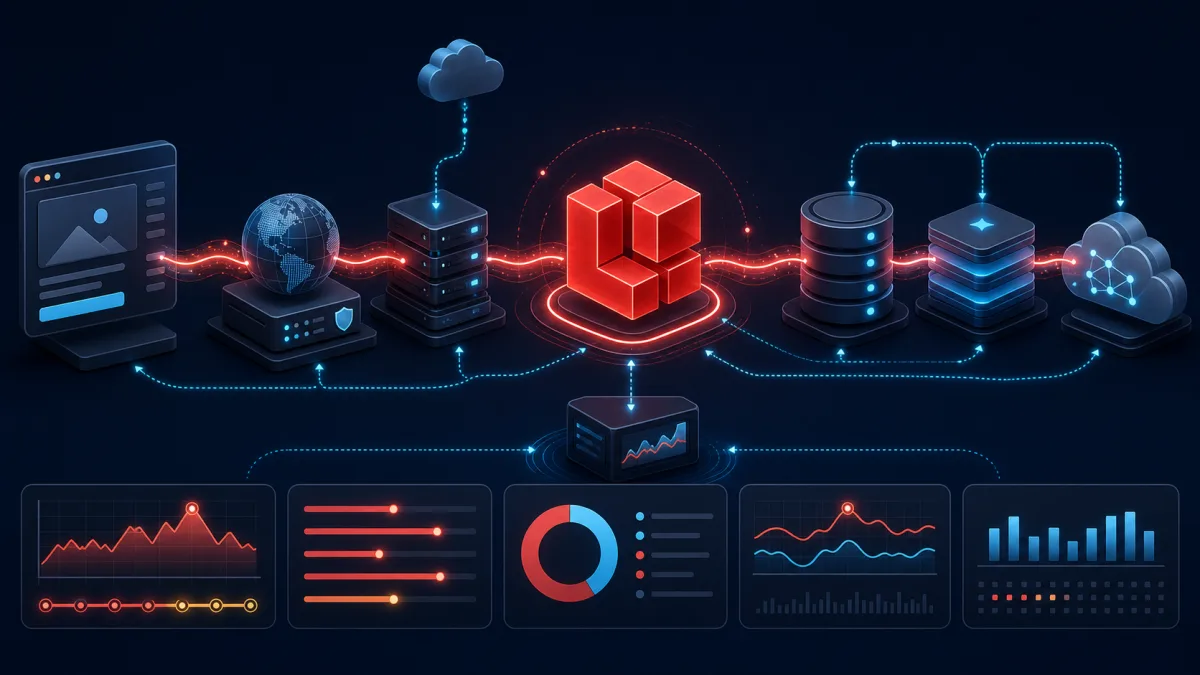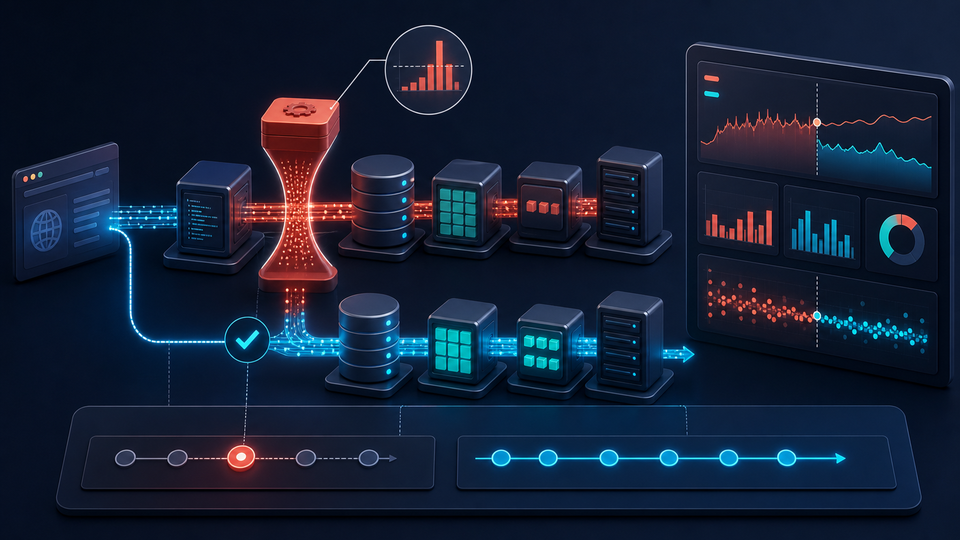
A Laravel application can return web pages quickly and still become unreliable as background work grows. The request finishes, but a video waits twenty minutes to process, a webhook is retried until it creates duplicate records, or a social-media publish action sits behind thousands of emails. These are not edge cases. They are signs that queue behavior has become part of the application’s production performance.
Good Laravel queue performance is not achieved by increasing a worker count until the backlog disappears. It requires understanding the jobs, queue driver, worker capacity, database, external APIs, infrastructure, and monitoring as one system. That production view also complements a broader review of PHP performance bottlenecks and fixes: moving work out of an HTTP request is valuable only when the new execution path remains observable and reliable.
What Laravel Queues Actually Solve
In synchronous processing, the user’s request remains open while Laravel completes every step. If a controller validates an upload, calls two APIs, generates thumbnails, and sends notifications before responding, the user absorbs the combined latency. One slow provider can turn a normally fast page into a timeout.
A queue changes the boundary. Laravel records a description of work, returns an appropriate response, and lets another process perform that work. The basic flow is:
This pattern improves perceived performance because the user waits for validation and dispatch, not the expensive operation. Video and image processing, API calls, email, notifications, reports, imports, exports, webhook processing, AI requests, social-media publishing, and data synchronization are common candidates. The interface should still communicate that the work is pending and provide a truthful status; a fast response that hides failure is not a performance improvement.
Queues also isolate workloads. A report can use a different queue and concurrency limit from a time-sensitive notification. That separation prevents one bursty workflow from consuming all available capacity. For a broader view of how these boundaries fit into delivery, see the Laravel development process from discovery through production.
Signs Your Laravel Queue Is Becoming a Bottleneck
The clearest signal is not simply “there are jobs in the queue.” A healthy busy system may always have work available. The more useful question is whether the system processes work within its service target and recovers after a burst. Warning signs include:
- Queue depth grows for a sustained period, and the oldest job age keeps rising.
- Jobs wait minutes before processing even though individual jobs finish quickly.
- Worker CPU is saturated, memory grows across jobs, or processes are repeatedly restarted.
- Laravel queue timeout failures, excessive retries, and failed jobs accumulate.
- Duplicate processing appears after timeouts or partial external API responses.
- More workers increase database contention or trigger provider rate limits.
- Users repeatedly refresh because an asynchronous operation has no useful progress state.
Distinguish slow jobs from insufficient worker capacity. If one job takes 90 seconds because it executes 3,000 queries, adding workers multiplies the inefficient database load. If a job takes 200 milliseconds but only one worker is handling a sustained 20 jobs per second, capacity is the immediate constraint. Runtime distributions, throughput, wait time, and dependency telemetry reveal which situation exists.
Choosing a Laravel Queue Driver for Production
Laravel supports several queue backends, and no driver is universally superior. The right choice depends on workload, operational experience, failure requirements, and where the application runs.
| Driver | Where it fits | Production considerations |
|---|---|---|
| Database | Smaller workloads and teams that want minimal infrastructure | Simple to operate, but polling and locking add load to the application database as volume and concurrency rise. |
| Redis | Low-latency queues, multiple named queues, and teams using Horizon | Excellent throughput and visibility with Horizon; Redis availability, memory, persistence, and eviction policy still need deliberate operations. |
| Amazon SQS | AWS-hosted systems that want queue infrastructure to scale independently | Durable managed messaging with useful CloudWatch metrics and dead-letter queues; visibility timeout, IAM, payload limits, and delivery semantics require careful configuration. |
A database queue may be entirely appropriate for a modest internal tool. Laravel Redis queues are a strong fit when low latency and Laravel Horizon are priorities. Laravel SQS is compelling when an application already operates on AWS and workers must scale separately. Choose from measured needs, not fashion, and include migration cost and operational ownership in the decision.
Designing Fast, Reliable Laravel Jobs
Laravel queue optimization begins inside the job. Keep each job focused enough that its runtime, retry behavior, and side effects are understandable. Pass stable identifiers instead of huge object graphs, then load only the fields and relationships required. Laravel can serialize models conveniently, but a small payload is easier to transmit, store, inspect, and evolve.
final class PublishVideo implements ShouldQueue
{
    public int $tries = 4;
    public int $timeout = 120;

    public function __construct(public readonly int $videoId) {}

    public function backoff(): array
    {
        return [15, 60, 300];
    }

    public function handle(VideoPublisher $publisher): void
    {
        $video = Video::query()
            ->select(['id', 'provider_id', 'source_path', 'published_at'])
            ->findOrFail($this->videoId);

        if ($video->published_at !== null) {
            return;
        }

        $publisher->publish($video);
    }
}
The guard makes repeat execution safer, but real idempotency often needs a database uniqueness constraint or a provider-supported idempotency key. A worker can fail after the provider accepts a request but before the application saves the response. The retry must reconcile that uncertain outcome instead of blindly creating the resource again.
Avoid N+1 queries, batch writes where correctness permits, and never load an unbounded collection into memory. Split a million-row export into coordinated chunks, but do not split work so finely that dispatch and coordination dominate runtime. Put timeouts around network calls as well as the job. The worker timeout should exceed the HTTP client timeout so Laravel can handle the failure instead of terminating in the middle of an uncontrolled socket wait.
Large jobs should define checkpoints or safe chunks. External latency should not hold a database transaction open. Record the local intent, commit, call the provider, and reconcile the result through an explicit state model. These disciplines matter in integration-heavy and AI SaaS applications, where provider runtime and cost vary far more than a typical database write.
Scaling Laravel Queue Workers Without Moving the Bottleneck
Throughput is approximately worker concurrency divided by average job runtime, but only while downstream dependencies can absorb the load. Adding Laravel queue workers eventually moves pressure somewhere else:
Horizontal scaling runs workers across multiple processes, hosts, or containers. Traditional deployments often use Supervisor to keep worker processes alive and restart them after deployments. Redis deployments may use Horizon supervisors and balancing. Container platforms can run dedicated worker services, while AWS ECS can adjust task count. Every approach needs graceful restart, memory limits, deployment coordination, and a clear method for preventing two releases from processing incompatible payloads.
Scale queues separately by workload. A high-priority webhook queue may need reserved capacity, while image transformations can use a larger, slower pool. Set concurrency from the strictest dependency: database connection capacity, CPU, memory, third-party API quotas, or storage throughput. Doubling workers is harmful if it exhausts the database connection pool or doubles API throttling.
What Laravel Horizon Adds
Laravel Horizon is designed for Redis-backed queues. It provides a dashboard for queue visibility, throughput, job runtime, failures, and worker behavior, plus configuration for supervisors, balancing strategies, environments, and queue allocation. It makes Laravel queue monitoring much more approachable when Redis is already the queue backend.
Horizon does not replace infrastructure and dependency monitoring. A runtime spike may be caused by a database lock or provider slowdown that Horizon cannot fully explain. Teams using SQS, another broker, or a centralized observability platform may instead combine queue metrics with application traces, structured logs, infrastructure dashboards, and alerts. The goal is correlated evidence, not a particular dashboard.
Laravel Queues on AWS with Amazon SQS
A practical Laravel AWS SQS architecture separates request-serving infrastructure from worker infrastructure:
The application places messages on SQS. A dedicated ECS service runs workers and scales independently from web containers. CloudWatch exposes signals such as visible messages, in-flight messages, and approximate age of the oldest message. Autoscaling can respond to backlog per worker or oldest-message age, ideally with minimum capacity for low-latency queues and conservative cooldowns to avoid oscillation.
Configure the SQS visibility timeout beyond the job’s realistic maximum runtime. Otherwise a still-running message can become visible and execute twice. Attach a dead-letter queue with a deliberate receive threshold, alert when messages arrive there, and document redrive procedures. IAM policies should give the application and worker roles only the queue actions and resources they need. If payloads approach SQS limits, store the large object in durable storage and queue a reference rather than the object.
SQS is not mandatory. It is useful when managed queue durability and independent scaling justify the additional AWS design. Teams considering that tradeoff can also review our guide to AWS DevOps and production delivery.
Handling Failed Jobs Correctly
Retrying every failure immediately can turn a provider outage into an application outage. Classify failures first. A network timeout, HTTP 503, or temporary lock is usually transient. Invalid input, revoked credentials, an unsupported file, or a deleted local record is usually permanent until something changes.
Transient failures should have bounded Laravel job retries with exponential backoff and jitter where practical. Permanent failures should fail quickly, preserve enough context for diagnosis, and notify the right owner. Store failed jobs or route exhausted SQS messages to a dead-letter queue. Log the job identifier, business entity, attempt number, provider, duration, and normalized error without exposing secrets or sensitive payloads.
Alerts should represent business risk: oldest critical job age, abnormal failure rate, or dead-letter arrival. Manual recovery must be documented and safe. Before replaying a job, an operator should know whether execution is idempotent, whether the external side effect may already exist, and which code version will handle it. Reliable recovery is a feature, not an improvised command during an incident.
Protecting External APIs and Their Rate Limits
Modern Laravel background jobs frequently call payment, email, AI, social, logistics, and CRM APIs. Worker scaling can overwhelm those providers even when the queue and database look healthy. Ten workers each making five requests per second produce 50 requests per second; adding containers multiplies that concurrency again.
Use Laravel’s rate-limited job middleware or a shared limiter so the limit applies across processes and hosts. Separate providers
into named queues when their service targets and quotas differ. Apply concurrency limits to expensive or non-thread-safe operations.
Honor Retry-After responses and provider-specific reset headers rather than retrying on a fixed loop.
public function middleware(): array
{
    return [new RateLimited('social-publishing')];
}

public function backoff(): array
{
    return [30, 120, 600];
}
Rate limiting and retry backoff solve different problems. A limiter controls normal aggregate demand; backoff slows repeated attempts after failure. Add circuit-breaking behavior when a provider has a sustained outage so workers do not spend all their capacity generating predictable failures. Preserve a per-provider queue when one degraded integration must not delay unrelated work.
Also control the production event that creates jobs. An accidental import of five million records should not silently fan out into five million immediate API calls. Validate scope, use batches with progress, provide cancellation where feasible, and expose the expected completion state to users.
Monitoring Laravel Queue Performance End to End
Queue depth alone does not tell the entire story. A depth of 10,000 may be healthy for 20-millisecond analytics events and critical for ten-minute video jobs. Monitor a group of related signals:
- Demand: incoming job rate, queue depth, and oldest job age by queue.
- Throughput: jobs completed per minute, average runtime, and percentile runtime.
- Reliability: failure rate, retry count, timeout count, duplicate-prevention events, and dead-letter volume.
- Capacity: active and idle workers, CPU, memory, restarts, and autoscaling activity.
- Dependencies: database connections and query latency, cache health, storage latency, and provider response status.
- Outcome: time from user action to completed business operation.
Alert on trends and service targets rather than isolated noise. Oldest job age is often more actionable than depth because it maps directly to user wait time. Processing rate compared with arrival rate shows whether a backlog will recover. Correlate a job ID through dispatch, worker logs, database changes, and external requests so an incident can be reconstructed.
Establish a normal baseline before choosing thresholds. A queue that grows during a nightly import and clears before business hours may be operating exactly as designed, while a small priority queue with a five-minute-old password-reset email may already be failing its users. Dashboards should separate queues by workload and environment, and deployments should be annotated so runtime, memory, or failure regressions can be connected to a release. Review the metrics after scaling as well: lower queue age accompanied by sharply higher database latency is evidence that capacity was moved, not created.
Example Production Queue Architecture
Monitoring surrounds every stage: request traces confirm dispatch latency, broker metrics show wait time, worker telemetry shows capacity and runtime, and dependency metrics explain slow execution. Business status records connect technical completion back to what the user sees. That feedback loop is what turns a collection of processes into an operable production system.
Laravel Queue Performance Checklist
- Measure queue depth, oldest job age, arrival rate, completion rate, and runtime percentiles by queue.
- Confirm whether delay comes from slow jobs or insufficient worker capacity.
- Profile database queries, memory, CPU, network calls, and payload size inside representative jobs.
- Use IDs or compact value objects instead of oversized serialized models and data.
- Define realistic HTTP, job, broker visibility, and process timeouts in the correct order.
- Make external side effects idempotent and test what happens after partial success.
- Classify transient and permanent failures; cap retries and apply backoff.
- Separate critical, bulk, and provider-specific workloads when they need different capacity or limits.
- Load-test downstream dependencies before increasing workers or enabling autoscaling.
- Alert on oldest-job age, failure rate, dead letters, and user-facing completion targets.
- Document deployment restarts, failed-job recovery, replay safety, and ownership.
When Queue Optimization Becomes an Architecture Problem
Sometimes Laravel slow jobs are symptoms rather than causes. A missing database index, an API that consistently takes 40 seconds, insufficient CPU, huge payloads, poor job boundaries, uncontrolled retries, or inefficient application logic will not disappear after changing queue drivers. Nor will a queue help if expensive work accidentally remains in the HTTP request.
At that point the investigation must cross code and infrastructure boundaries. Trace one business operation from the user action through dispatch, processing, data changes, integrations, and visible completion. That systems approach is also central to Laravel maintenance and production support: reliable software requires continued attention to behavior after release, not only code generation before it.
Laravel production performance is usually a systems problem. The durable fix may combine smaller jobs, a query change, controlled concurrency, an API-specific queue, stronger status modeling, and better alerts. Optimize the constraint that evidence identifies, then measure the whole path again.
Need help with slow or unreliable Laravel background jobs?
Custom PHP Design can diagnose, optimize, modernize, and scale existing Laravel applications across code, queues, databases, integrations, AWS infrastructure, and monitoring.
Explore AWS & Laravel DevOps services