A Laravel application does not become production-ready when its last controller is written. It becomes ready when the business rules are understood, the data model can preserve them, releases are repeatable, failures are visible, and someone knows how the system will be operated after launch.
This guide follows the professional Laravel development process from an initial business idea to a dependable production system. It is written for founders, business owners, CTOs, and technical decision-makers who need to understand what happens between “we should build this” and “customers can rely on it.” For a broader framework overview, begin with our complete guide to Laravel development in 2026.
What is the Laravel development process?
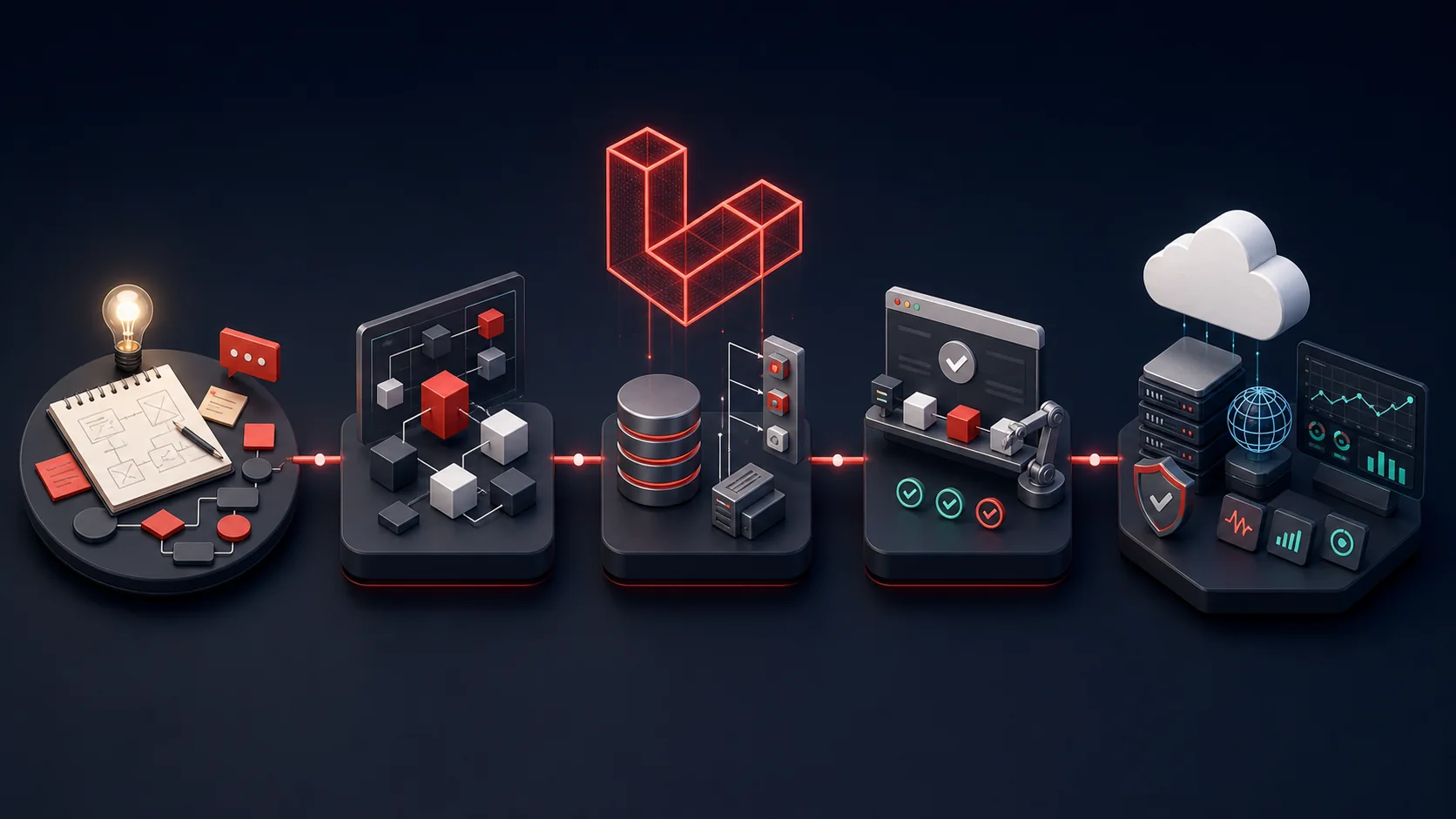
The Laravel development process is the sequence used to turn a business problem into an operated software product. It includes discovery, MVP definition, Laravel application architecture, database design, implementation, frontend work, testing, security review, deployment, monitoring, and continued improvement. Coding is central, but it is only one part of the work.
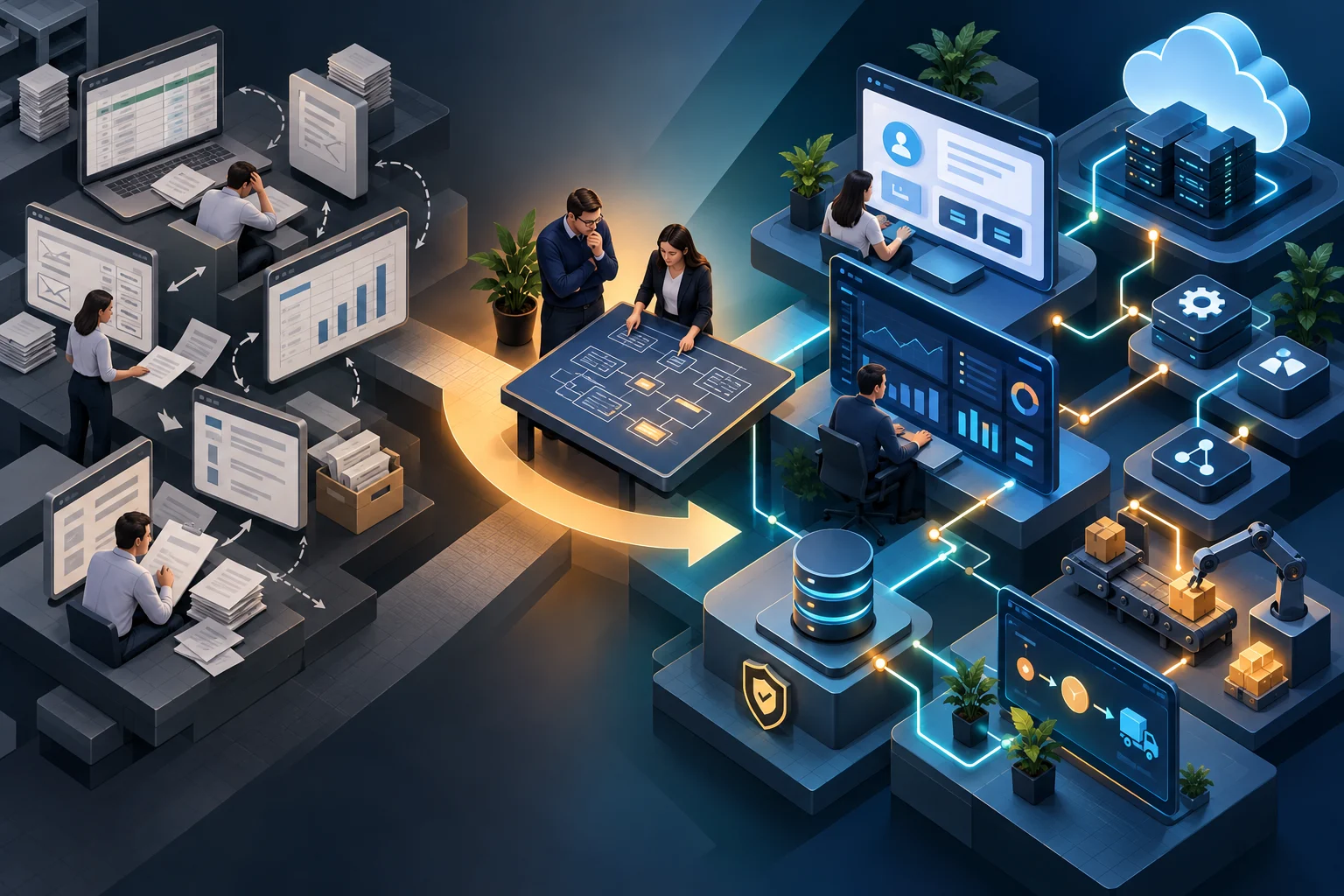
Consider a distributor replacing email, spreadsheets, and manual status calls with a customer portal. The visible screens may look straightforward: orders, documents, approvals, and status. Underneath, the system must decide who can see each account, which source owns inventory, how duplicate submissions are prevented, what happens when the ERP is unavailable, and how staff can recover from an incorrect approval. Those decisions determine whether the application removes work or merely moves the confusion into a browser.
A professional process makes these questions explicit early, then carries the answers through code, infrastructure, and operations. That lifecycle focus distinguishes application delivery from a collection of features. Our overview of what businesses should expect from Laravel development services explains how those responsibilities fit into a professional engagement.
If the business case for the framework is still being evaluated, the companion article on why companies choose Laravel for custom web applications covers the capabilities and ownership advantages behind that decision.
1. Understand the business problem before choosing features
Discovery begins with the current workflow, not a framework feature list. The team interviews the people who perform and manage the work, observes handoffs, identifies authoritative data, and documents exceptions. It asks what delays cost, which mistakes create risk, and how success will be measured.
Turn workflow knowledge into requirements
“Build an approval system” is not yet an actionable requirement. Who can submit? Can an approver edit a request? Are two approvals required above a threshold? What happens when someone is absent? Must every change be retained for audit? Useful requirements combine a user, an outcome, a rule, and an observable acceptance condition.
This stage should also uncover integrations, reporting expectations, privacy obligations, migration needs, traffic patterns, and availability targets. A payment workflow, for example, needs more than a checkout screen. It needs webhook verification, idempotency, reconciliation, failure states, refunds, access controls, and a support path.
Define the MVP around a business result
An MVP is the smallest release that proves a valuable workflow, not every idea labeled “phase one.” The distributor might begin with customer order visibility and document exchange while leaving advanced forecasting for later. That release can reduce status calls, establish a trustworthy data boundary, and generate feedback without delaying value for months.
Scope should state what is included, what is deferred, what assumptions affect the estimate, and which acceptance criteria close each feature. The guide to building custom Laravel software around real business workflows offers more context on choosing this investment over packaged tools.
2. Plan the Laravel application architecture
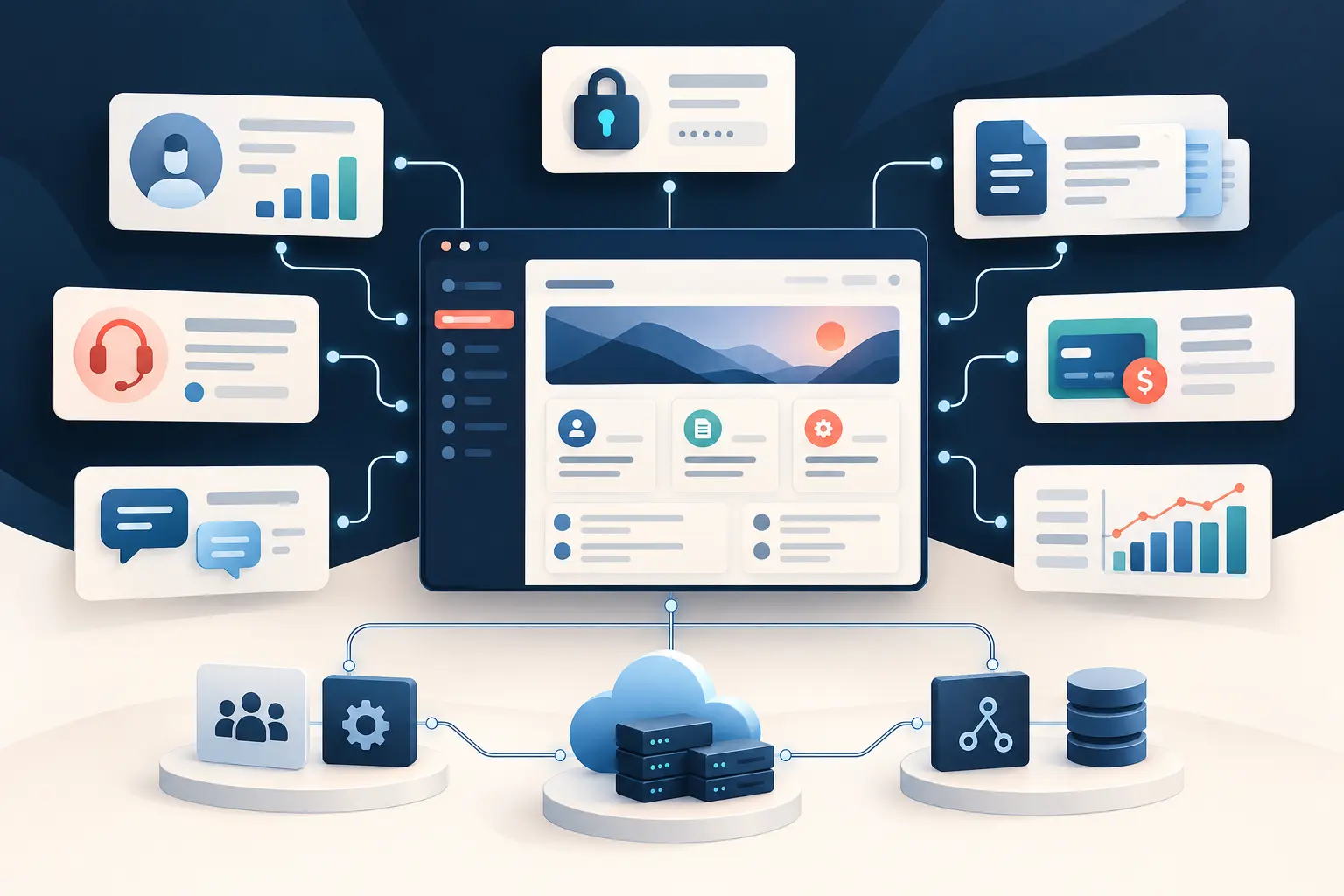
Architecture translates product constraints into technical boundaries. A typical Laravel application might use Blade, Livewire, Vue, or React for its interface; Laravel for business behavior and APIs; MySQL for transactional data; object storage for files; and selected external services for payments, messaging, search, or AI. The right combination depends on the product, team, risk, and expected operating load.
Keep business logic in understandable boundaries
Controllers should coordinate requests, not become the application. Validation belongs in Form Requests where appropriate, authorization in policies and gates, and meaningful operations in focused services or actions. Eloquent models express data relationships, but complicated workflows benefit from explicit domain behavior that can be tested without simulating an entire browser request.
A modular monolith is often a strong starting point for custom business applications. Billing, accounts, fulfillment, and reporting can have clear internal boundaries while sharing one deployment and database. Microservices are justified when independent scaling, ownership, or isolation solves a demonstrated problem, not simply because the system may grow.
Design for failure at system boundaries
Every external API eventually times out, returns an unexpected payload, or changes behavior. Laravel API development should define timeouts, authentication, rate-limit handling, safe retries, idempotency, validation, and useful failure records. Webhooks must be verified and safe to receive more than once. Slow work can use queues where reliable workers are part of the deployment; scheduled jobs need an owned execution and alerting model. When persistent workers or a scheduler are not available, application-triggered or webhook-driven processing can be a better fit.
These choices should be captured in short decision records so another Laravel developer can understand why a boundary exists. If framework choice itself remains open, compare Laravel development with a custom PHP approach.
3. Design the database around integrity and change
Database design is application design. Tables, constraints, indexes, and transaction boundaries must preserve the rules the business depends on. An order identifier that must be unique should have a database constraint, not only a form check. A transfer between two balances needs a transaction. Records that carry legal or financial meaning may need immutable events or an audit trail rather than a mutable notes field.
Model concepts, relationships, and history
Start with the domain language: customers, organizations, subscriptions, orders, approvals, assets, or cases. Identify cardinality, ownership, lifecycle states, and retention needs. Avoid both extremes: one giant table that mixes unrelated concerns and an abstract schema that makes ordinary queries difficult.
Migrations should be forward-safe and reviewed with production data volume in mind. Adding a non-null column or rebuilding a large index can behave very differently on a populated database than in development. For legacy PHP modernization, data mapping, compatibility, and staged cutovers deserve their own plan; our legacy application modernization services focus on reducing that change risk.
4. Build the application in reviewable increments
Implementation works best as a series of thin, complete slices. A team might first deliver account invitation from database through interface, then permissions, then a basic order workflow. Each slice includes validation, authorization, error handling, tests, and documentation rather than postponing quality until a hardening phase.
Authentication and authorization are different
Authentication establishes identity. Authorization decides what that identity may do with a particular record. A signed-in account manager should not automatically see every customer. Policies can express ownership, organization membership, roles, and record state close to the protected action. Server-side enforcement remains necessary even when the interface hides unavailable controls.
Integrations need operational behavior
A CRM sync is incomplete if it only handles successful API calls. Production code must log correlation details without exposing secrets, distinguish retryable failures from invalid data, avoid duplicate side effects, and give support staff enough information to resolve exceptions. Custom PHP Design works across custom Laravel application development, APIs, databases, and third-party services because these boundaries frequently determine the reliability of the whole product.
5. Build the frontend around the actual job
Frontend development is not a decorative pass after backend work. Navigation, forms, validation feedback, loading states, keyboard access, responsive behavior, and error recovery directly affect whether users can complete a workflow correctly.
Choose the lightest frontend architecture that supports the interaction model. Server-rendered Blade can be excellent for content and conventional forms. Livewire can add reactive behavior while keeping a Laravel-centered team. Vue or React may suit highly interactive products with complex client state. The decision should account for accessibility, performance, maintainability, and team capability rather than fashion.
Test interfaces with realistic data. A dashboard that looks clean with three sample rows may fail with a long company name, 40 filters, a mobile viewport, or a user who lacks permission for half the actions. Early prototypes help validate flow; production implementation must handle the uncomfortable cases too.
6. Use Git and source control as a delivery system
A disciplined Git workflow makes changes understandable and reversible. Work should be divided into focused branches or change sets, reviewed through pull requests, and connected to an issue or outcome. Commits need enough context to explain intent without combining unrelated cleanup.
Review examines behavior, permissions, failure paths, database impact, compatibility, tests, and operational consequences. Configuration is separated from code, secrets remain outside the repository, and environment-specific differences are documented.
7. Test behavior, integrations, and release readiness
Automated testing creates fast feedback around the rules most likely to break. Unit tests fit isolated calculations and domain behavior. Feature tests verify HTTP endpoints, validation, authorization, database changes, and rendered responses. Integration or contract tests exercise the assumptions made about external systems, while browser tests protect a small number of high-value journeys.
Test the failures the business cares about
A useful suite goes beyond the happy path: two users update the same record, a webhook arrives twice, a payment succeeds after the browser closes, an API times out, or an unauthorized user guesses a URL. These cases often reveal the difference between demo software and a reliable business application.
Manual testing remains valuable for exploratory behavior, usability, accessibility, and release-specific risk. Before launch, business stakeholders should validate acceptance criteria against representative data in a production-like environment. Automated checks make regression cheaper; informed human review finds ambiguity the checks did not encode.
8. Address security and performance before production
Laravel provides strong defaults for common web risks, but secure Laravel web development still requires application-specific decisions. Validate untrusted input, authorize every protected action, escape output, protect credentials, use secure cookies, limit sensitive logging, rate-limit exposed endpoints, and keep framework and package dependencies current. File uploads, exports, impersonation, admin tools, and third-party callbacks deserve deliberate threat review.
Performance work begins with measurement. Query logs and plans can reveal missing indexes, N+1 queries, or unbounded results. Application traces expose slow external calls. Cache metrics show whether caching helps. Improvements might include eager loading, pagination, background processing where supported, response caching, query changes, or infrastructure adjustments.
Load testing should model a meaningful workflow and realistic data, not merely hit the home page. Capacity targets, acceptable latency, and degradation behavior should be understood before a campaign or customer rollout creates the first serious test.
9. Create repeatable Laravel CI/CD
Continuous integration checks every proposed change in a consistent environment. A practical Laravel CI/CD pipeline may install locked dependencies, run static analysis, execute automated tests, compile frontend assets, and scan for known vulnerabilities. A failure stops promotion rather than becoming a warning people learn to ignore.
Continuous delivery packages the approved code into a known release and moves it through environments. Docker can reduce differences between development, CI, and production. Infrastructure as Code makes networks, permissions, databases, and application resources reviewable and repeatable. Neither tool removes operational judgment, but both reduce hidden manual steps.
Plan deployment and rollback together
A safe Laravel deployment coordinates code, configuration, caches, storage, workers where used, and database migrations. Health checks should verify more than whether a process started. Database changes should remain compatible during the transition, and rollback expectations must account for data changes that cannot simply be reversed.
Deployment automation should record who released what and when. For a closer infrastructure view, read our guide to AWS DevOps and CI/CD for dependable production delivery.
10. Deploy Laravel to AWS or another production platform
Laravel AWS deployment might use load-balanced compute or containers, a managed relational database, object storage, a cache, centralized logs, a content delivery network, and carefully scoped identity permissions. A smaller application may need far less. Managed Laravel platforms or another cloud provider can be sensible when they match the operational requirements and team.
The goal is not the largest architecture diagram. It is an environment with appropriate isolation, encrypted connections and storage, secrets management, backups, health checks, scaling options, and a clear ownership model. Production and non-production resources should be separated. Access should follow least privilege, and emergency procedures should be documented before they are needed.
Custom PHP Design supports AWS infrastructure and Laravel DevOps, including Docker, CI/CD, Infrastructure as Code, production deployment, and operational improvements. Keeping application and infrastructure decisions connected prevents a design that works locally but is fragile to release.
11. Operate, maintain, and improve the application
Launch changes the kind of evidence available. Structured logs, exception tracking, application performance monitoring, infrastructure metrics, and business events reveal what users and systems are actually doing. Alerts should identify actionable conditions such as elevated errors, slow critical transactions, failed integrations, resource pressure, or missed processing.
Backups are only useful when restoration works
Define recovery point and recovery time expectations, automate database and file backups, retain them appropriately, and test restoration. A successful backup job does not prove that the application, database, object files, encryption keys, and configuration can be reconstructed together.
Maintenance is continued product stewardship
Laravel application maintenance includes dependency and security updates, incident response, performance review, provider changes, data corrections, documentation, and new development. Small updates delivered regularly are usually easier to reason about than years of deferred upgrades.
User feedback and operational data should feed the next planning cycle. A portal may need self-service reporting after order visibility succeeds; a SaaS MVP may add billing controls after it proves activation. The guide to building a production AI SaaS application shows how this lifecycle becomes even more important when model cost, latency, privacy, and uncertain output enter the system.
12. Scale with evidence as the business grows
Scaling is not automatically splitting the application into services. First identify the constraint. Database load may improve through indexing, query changes, read strategies, or archiving. Heavy reports may need asynchronous processing. Static files may belong behind a CDN. A slow provider may require caching, batching, or an explicit degradation path. Organizational scaling may require clearer module ownership and documentation more than new infrastructure.
A well-structured Laravel application can grow substantially as a modular monolith. Extract a service only when the boundary, ownership, failure isolation, or independent scaling benefit justifies the added network and operational complexity. Experienced Laravel partners should explain these tradeoffs in business terms rather than prescribing complexity by default.
Frequently asked questions
What is the Laravel development process?
It is the complete lifecycle for turning a business need into operated Laravel software: discovery, scope, architecture, data design, implementation, testing, security, deployment, monitoring, maintenance, and growth. The phases overlap, but each produces evidence needed for sound decisions.
How long does Laravel application development take?
A focused MVP can take several weeks. A complex platform involving data migration, multiple integrations, custom permissions, compliance, or high availability can take several months or longer. Discovery produces a more defensible estimate by exposing dependencies and defining the first valuable release.
What happens before Laravel development begins?
The team studies users, current workflows, business rules, data, integrations, constraints, risks, and measurable outcomes. It defines an MVP, acceptance criteria, architecture direction, and delivery plan before significant implementation begins.
How is a Laravel application deployed to production?
A CI/CD pipeline typically verifies the change, builds a known artifact or container, applies compatible migrations, promotes configuration securely, deploys to the target environment, and checks application health. The release process also needs rollback and incident procedures.
Is Laravel suitable for large business applications?
Yes. Laravel can support substantial applications when the architecture has clear boundaries, data access is efficient, permissions are enforced, integrations are resilient, and infrastructure is operated well. Scale depends more on system design and operational discipline than framework branding.
What happens after a Laravel application launches?
The team monitors errors and performance, verifies backups, responds to incidents, applies security and dependency updates, studies user feedback, and delivers improvements through the same tested release process. Production is the beginning of informed application maintenance, not the end of development.
Move from idea to a production plan
Professional Laravel application development connects product decisions to architecture, database integrity, secure implementation, testing, infrastructure, deployment, and ongoing ownership. Missing any one of those areas can turn a promising application into an expensive operational problem.
Custom PHP Design helps businesses plan and deliver custom Laravel applications, replace legacy PHP systems, build APIs and integrations, design MySQL architecture, and improve AWS, Docker, CI/CD, Infrastructure as Code, monitoring, and production support. If you are planning a new application or need to make an existing Laravel system safer and easier to evolve, contact Custom PHP Design to discuss a practical first phase.