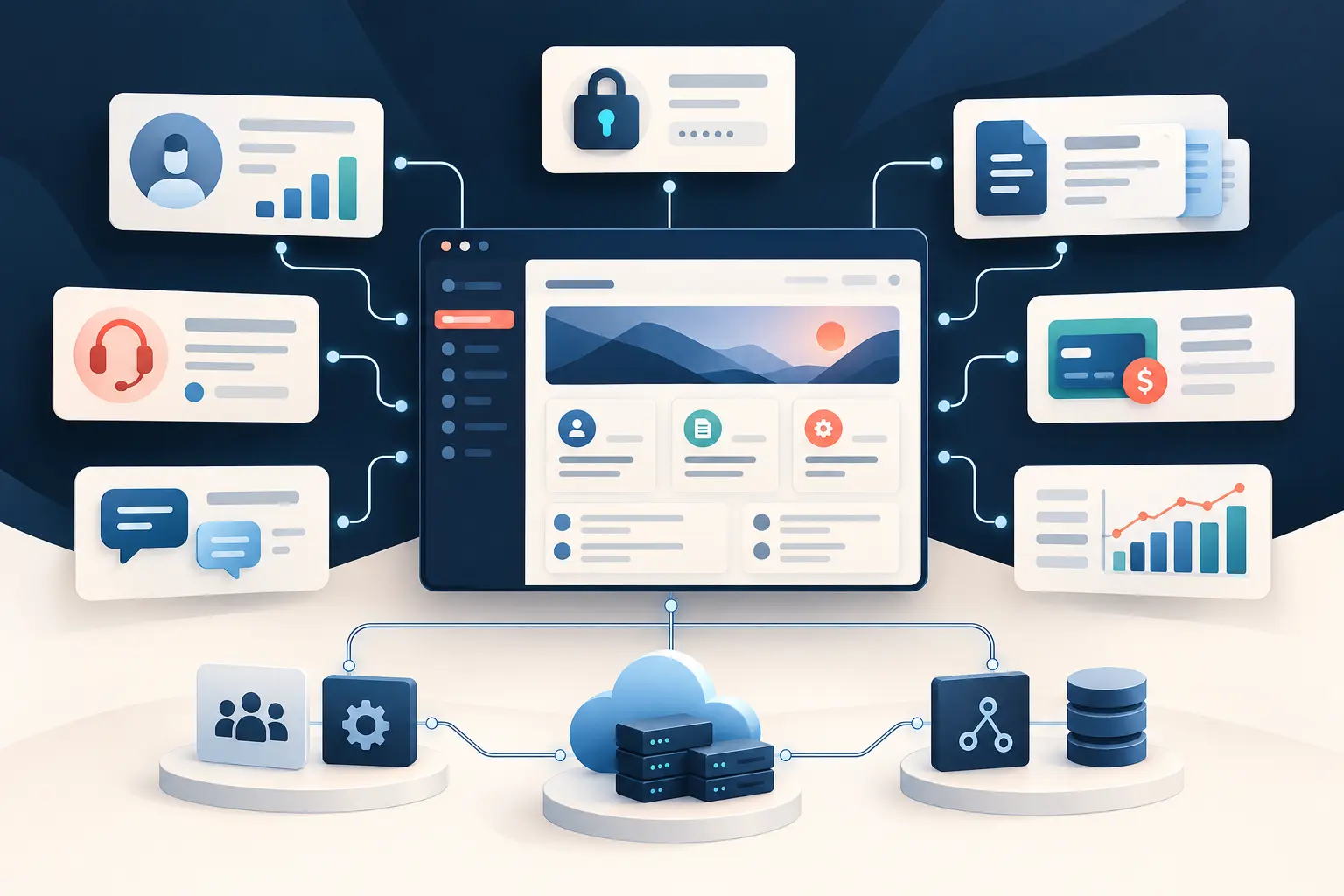
Laravel web design can mean a polished company website, but the phrase often describes a larger need: a website that must also recognize users, protect data, connect systems, enforce business rules, or complete transactions. Laravel can support the visible experience, yet its greatest value appears when the site must behave like software—not merely publish pages.
The practical question is therefore not “Can Laravel design a website?” It can. The better question is what the business needs visitors, customers, and employees to accomplish. A marketing site may need excellent content, accessibility, performance, and conversion paths. A customer portal or SaaS product adds accounts, permissions, workflows, integrations, reporting, and operational responsibility. Those are different projects even when both open in a browser.
What Does Laravel Web Design Mean?
Web design traditionally covers information architecture, page layout, visual hierarchy, typography, responsive behavior, accessibility, interaction design, and the path from a visitor’s question to a useful next step. It answers questions such as: What belongs on the page? Can users understand it quickly? Does it work on a phone? Is the primary action clear?
Laravel is a server-side PHP framework, not a visual design application. A designer can create an interface independently of Laravel, while a Laravel developer turns that interface into maintainable templates, components, routes, forms, data-backed screens, and application behavior. Professional Laravel web development joins those disciplines without confusing them.
For a content-led website, Laravel may render fast, reusable pages and handle contact forms or a modest content workflow. For an application, the same interface may be the entry point to authentication, role-based access, database records, payments, notifications, APIs, and automation. The browser experience is what users see; the application architecture determines whether their actions remain correct and dependable.
Laravel Website vs. Laravel Web Application
A website primarily communicates. A web application primarily enables users to perform work. Real projects often combine both, but identifying the dominant purpose prevents a brochure-site estimate from being applied to an operating system for the business.
| Business need | Traditional website | Laravel web application |
|---|---|---|
| Primary goal | Inform, establish trust, generate inquiries | Complete a workflow or transaction |
| Users | Mostly anonymous visitors | Customers, staff, vendors, or administrators |
| Data | Mostly published content | Related, changing, user-specific records |
| Rules | Simple forms and presentation logic | Permissions, approvals, calculations, states, and exceptions |
| Connections | Analytics, email, maps, basic embeds | Payments, APIs, webhooks, accounting, CRM, fulfillment, or AI services |
| Operational risk | Missed leads or unclear information | Incorrect data, unauthorized access, failed transactions, or interrupted operations |
A public pricing page is a website feature. A pricing engine that calculates customer-specific rates, applies contract terms, routes exceptions for approval, and records an audit trail is application functionality. The screens may look equally simple. The engineering beneath them is not.
When a Traditional Website Is Enough
A traditional site is usually sufficient when the business needs to explain services, publish resources, establish credibility, showcase work, collect inquiries, and direct prospects to a conversation. It still deserves professional design, clear copy, semantic HTML, accessible controls, responsive layouts, fast images, technical SEO, analytics, security updates, and reliable hosting.
Laravel can power that site, especially when the organization already uses Laravel, expects custom content behavior, or wants one technical foundation for future expansion. But a framework should not be selected only because it is powerful. A simple site does not automatically need user accounts, a complex database, or custom administration. Unnecessary application features add build time and a larger maintenance surface.
If the goal is primarily lead generation, invest first in the message, page structure, proof, performance, and conversion path. Build application behavior only where it removes a real constraint or enables a valuable customer experience.
When You Need Laravel Application Development
You have crossed from website work into Laravel application development when the system must understand who a user is, what that person may do, which records belong together, and what should happen after an action. Common signals include:
- Customers or employees need secure accounts and role-specific screens.
- A workflow moves through statuses, approvals, assignments, or exceptions.
- Pricing, eligibility, scheduling, or fulfillment depends on business rules.
- The product accepts payments, subscriptions, orders, uploads, or sensitive data.
- Information must move between a CRM, ERP, accounting system, vendor API, or another platform.
- Leaders need dashboards and reports built from operational data.
- Manual spreadsheets and email handoffs are creating delays or mistakes.
- The business is selling software as a service.
This is where Laravel web application development becomes materially different from assembling pages. The application must preserve data integrity, handle failure paths, enforce access consistently, remain testable, and support future changes without making every release hazardous.
What Goes Into a Professional Laravel Web Application?
A credible application begins with the business model, not a list of framework features. Discovery identifies the users, desired outcomes, current process, source of truth, edge cases, compliance needs, and cost of failure. Architecture then gives those requirements durable boundaries.
Authentication and permissions
Signing in is only the beginning. The system must define which roles may view, create, approve, export, modify, or delete each kind of record. Multi-tenant products must reliably keep one organization’s information separate from another’s.
Data and business rules
Database relationships should reflect the real domain: customers, subscriptions, projects, orders, assets, approvals, or whatever the business operates. Validation protects individual inputs; domain rules protect the workflow across time. Tests should cover important decisions and failure conditions, not only whether a page loads.
Integrations and background behavior
APIs and webhooks require authentication, timeouts, rate-limit handling, idempotency, useful logs, and reconciliation when systems disagree. Email delivery, document processing, imports, notifications, and other slow work also need an execution model appropriate to the deployment. The architecture must fit the operating environment rather than assuming infrastructure that will not exist.
Delivery and operation
Production work includes configuration, secret management, database changes, automated verification, controlled releases, monitoring, backups, and recovery. The Laravel development process should connect these responsibilities to each feature instead of postponing them until launch.
Laravel Frontend Options in 2026
Laravel does not force every product into one frontend approach. The right choice depends on the interaction model, team skills, performance needs, and expected lifespan.
- Blade is Laravel’s server-rendered templating system. It is an excellent fit for content pages, forms, account areas, and applications where straightforward requests and responses keep complexity low.
- Livewire adds reactive interactions while keeping most application work in PHP. It suits dashboards, filters, administrative tools, and dynamic forms when a separate JavaScript application would add more architecture than value.
- Alpine.js handles lightweight browser interactions such as menus, toggles, and modest interface state. It often complements Blade or Livewire.
- Inertia with Vue or React supports richer single-page-style experiences while preserving Laravel routing and controllers. It can be appropriate for highly interactive products and teams already strong in those ecosystems.
- An API-backed frontend separates the Laravel backend from a web or mobile client. That independence can be useful, but it introduces API contracts, authentication boundaries, versioning, and additional deployment concerns.
The most modern-looking option is not automatically the best. A restrained Blade interface can be faster to deliver and easier to own than a separate frontend application. Conversely, forcing a highly interactive workspace into basic page reloads can damage usability. Design the interaction first, then choose the smallest architecture that supports it well.
Why Design and Backend Architecture Need to Work Together
A mockup can show an ideal state; production software must also show empty states, invalid input, partial permissions, slow dependencies, duplicate submissions, expired sessions, and failed payments. Those are both design and engineering concerns. If they are discovered only after the interface is approved, important workflows get squeezed into components that were never designed to explain them.
The relationship also runs in the other direction. Backend models should not dictate awkward user experiences merely because the tables were designed first. A customer may think in terms of “renew my plan,” while the database records invoices, entitlements, payment attempts, and subscription transitions. Good interface design presents the customer’s task clearly while the application preserves the underlying rules.
Accessibility, performance, and security benefit from the same collaboration. A responsive screen needs realistic data. A file upload needs clear constraints and progress feedback. A destructive action needs authorization, confirmation, and an audit trail. Effective custom Laravel development treats these as one product rather than separate design and coding handoffs.
Businesses That Benefit From Custom Laravel Development
Laravel is especially useful when off-the-shelf software almost fits but forces the business into costly workarounds. Examples include:
- A service company replacing emailed forms with a customer portal for intake, documents, status updates, and approvals.
- A distributor creating account-specific catalogs, contract pricing, order rules, and fulfillment integrations.
- A healthcare-adjacent operation coordinating permitted access, structured workflows, audit needs, and integrations without claiming that a framework alone provides compliance.
- A SaaS founder building tenant accounts, subscriptions, feature access, onboarding, reporting, and administration around a distinct product idea.
- An operations team replacing spreadsheets with assignments, approvals, exception queues, reporting, and an authoritative history.
- An established business modernizing a valuable custom PHP system incrementally instead of discarding its proven business logic.
For broader planning, see the Laravel Development Guide, our focused guide to custom Laravel development, and the custom PHP development guide.
Laravel Web Design Cost vs. Application Development Cost
A brochure-style website and a custom application have dramatically different scopes because they carry different responsibilities. Website effort is commonly concentrated in discovery, content, page templates, responsive design, accessibility, performance, forms, analytics, and launch. Application effort adds domain modeling, authentication, permissions, workflow states, integrations, data migration, testing, infrastructure, observability, and ongoing product decisions.
A beautiful dashboard mockup does not estimate the rules behind its numbers. Likewise, a list of Laravel features does not estimate how many roles, exceptions, integrations, and historical records the team must support. Responsible estimates are built around complete workflows and known risks.
AI-assisted development can accelerate scaffolding, tests, documentation, repetitive frontend work, and code investigation. Experienced review remains responsible for architecture, security, data, edge cases, and release behavior. For engagement models and the factors that affect a real estimate, read How Much Does Laravel Development Cost in 2026?
How to Choose a Laravel Web Development Partner
Choose a partner based on the system you need, not the broadest capability list. A design-led marketing site may benefit most from strong brand, content, conversion, accessibility, and frontend craft. An operational application requires deeper experience with data modeling, authorization, integrations, tests, deployment, and production diagnosis. A combined project needs both disciplines to communicate directly.
Ask a prospective Laravel development company to explain:
- how it separates business requirements from assumed features;
- who owns interface design, application architecture, testing, and deployment;
- how permissions, data integrity, API failures, and sensitive configuration are handled;
- how existing systems and data will be assessed before changes begin;
- what evidence demonstrates that a release is safe;
- how the application will be monitored, supported, and transferred;
- where AI assists delivery and where human review remains mandatory.
Clear answers should connect technology to business risk. Our guide to choosing a Laravel development company offers a fuller evaluation framework, while our Laravel application development services describe the kinds of systems we build and improve.
Laravel Web Design FAQ
Is Laravel good for web design?
Laravel is good for implementing a professionally designed website when the project benefits from server-rendered templates, reusable components, custom forms, content logic, or future application features. Visual design still requires deliberate UX, content, accessibility, and frontend work.
Can Laravel be used to build a website?
Yes. Laravel can power marketing sites, content websites, portals, ecommerce systems, dashboards, and full web applications. Whether it is the right foundation depends on the site’s behavior, ownership needs, integrations, and expected evolution.
What is the difference between Laravel web development and web design?
Web design defines the structure, appearance, interaction, and user journey. Laravel web development implements that experience and, when needed, adds server-side data, authentication, permissions, workflows, integrations, and production operation.
Is Laravel better for websites or web applications?
Laravel can support both, but its framework capabilities deliver the most value in web applications and websites with custom behavior. A simple informational site may not need all that capability.
How much does Laravel web development cost?
Cost depends on the workflows, number of page and interface types, user roles, data model, integrations, migration, testing, infrastructure, and support expectations. A discovery process is necessary for a defensible estimate.
Do I need Laravel for a simple business website?
Not necessarily. If the site primarily publishes information and captures leads, several platforms may be appropriate. Laravel becomes more compelling when custom behavior, integration, ownership, or a path toward application features matters.
Can Laravel build a SaaS application?
Yes. Laravel is well suited to SaaS products with tenant accounts, subscriptions, permissions, APIs, notifications, administration, and reporting. Product architecture must still address isolation, billing states, security, scaling, and operational support.
Can an existing website be converted into a Laravel application?
Yes, but conversion should begin by identifying which content, URLs, data, integrations, and business behavior must be preserved. Incremental migration is often safer than replacing everything at once, particularly when the current site already supports revenue or operations.
Start With the Business Workflow
The strongest Laravel solution is not automatically the one with the most custom code. It is the one that gives users the right experience, gives the business control over important workflows, and remains understandable in production. Sometimes that is a focused website. Sometimes it is a portal, SaaS platform, transactional system, API-backed product, or custom automation application.
Custom PHP Design provides custom PHP development and Laravel engineering across interface implementation, business logic, databases, integrations, AWS delivery, and existing-system modernization. If you are deciding between a website and a deeper application, book a conversation about the workflow you need to support.