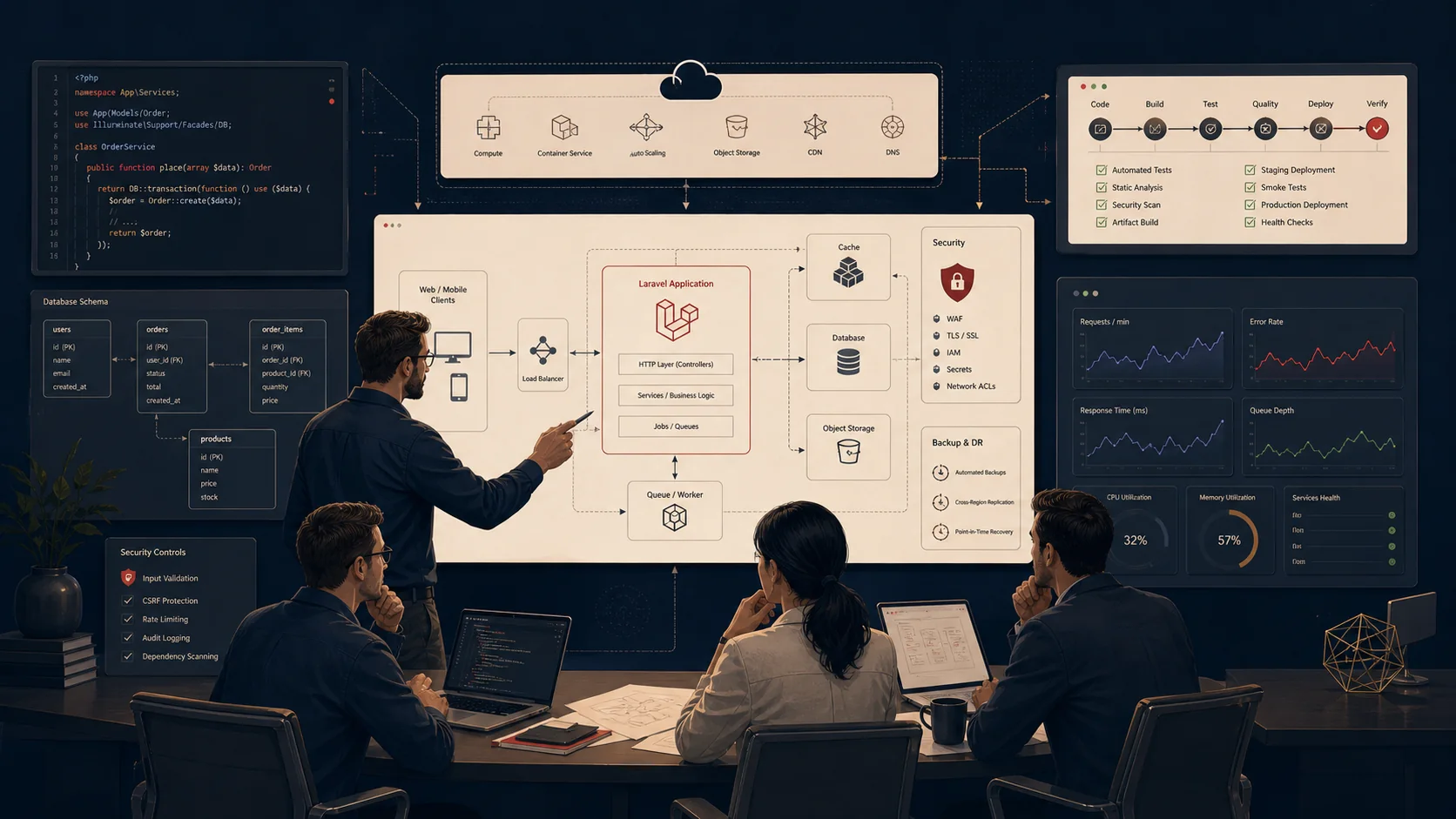
To hire a PHP developer long term is to choose continuing technical ownership, not simply purchase a larger block of coding hours. The developer learns why the application works as it does, which workflows affect revenue, where operational risks live, and how new requests fit the product’s direction. That context can make every future change safer and more efficient.
The arrangement still needs structure. “Ongoing help” can otherwise become a vague promise with uncertain availability, an unmanaged backlog, and no shared definition of success. Businesses should understand the engagement model, confirm the developer’s production experience, establish control of accounts and intellectual property, and agree on how priorities and releases will be managed.
This guide focuses on that continuing relationship. If you are making your first technical hire for a narrowly defined need, begin with our small-business PHP developer hiring checklist. If you are comparing agencies or multi-discipline teams before choosing an ongoing provider, review how to evaluate a custom PHP development company.
When does a long-term PHP developer make sense?
A long-term relationship makes sense when the software is part of how the business operates and will continue changing. A customer portal gains new workflows. An internal application must follow new policies. A Laravel product needs integrations, security updates, performance work, and improvements based on user feedback. Even a stable application depends on external services whose APIs, authentication rules, and support windows change.
Common signs that continuing support is appropriate include:
- The application supports revenue, customers, staff, or essential reporting.
- There is a recurring backlog of fixes, refinements, and feature requests.
- The business expects ongoing Laravel development after the current project.
- PHP, Laravel, Composer packages, or integrations need planned updates.
- Knowledge is concentrated in one former employee or vendor.
- Production issues require someone who already understands the system.
- Leadership needs technical input before committing to product decisions.
A one-time project remains appropriate when the result is genuinely self-contained and the business has someone else to own what follows. The question is not whether the initial scope has an end date. It is whether the application will still need informed decisions after that date.
Dedicated developer, retainer, or project contract?
These terms are sometimes used interchangeably, but they create different expectations.
Dedicated PHP developer
A dedicated PHP developer typically reserves a substantial share of working capacity for one client. The developer may operate like an embedded member of the business team, attend planning sessions, maintain a backlog, and coordinate frequently with internal stakeholders. This model fits a steady volume of product work that justifies predictable weekly involvement.
“Dedicated” should not be accepted as a marketing label. Confirm how much capacity is actually reserved, who performs the work, whether another person can be substituted, which hours overlap with your team, and what happens during leave or emergencies.
PHP development retainer
A PHP development retainer reserves a defined level of access or capacity each month. It can work well for a business with recurring but variable needs: maintenance, small features, technical advice, integration changes, and occasional incident investigation. The retainer buys continuity and planning capacity; it should not imply unlimited work.
A useful agreement states the included capacity, response expectations, supported systems, communication channel, rollover or expiration policy, and treatment of work that exceeds the allowance. It should also separate routine prioritization from genuine production incidents.
Project contract
A project contract is organized around a defined outcome, such as an upgrade, integration, portal, or reporting module. It usually has milestones, acceptance criteria, and a completion point. This gives cost and delivery clarity when the problem is sufficiently understood, but it does not automatically provide capacity after handoff.
The models can be combined. A business might use a discovery project to assess an inherited application, a defined project to stabilize urgent risks, and then a retainer for maintenance and planned improvements. That sequence is often more responsible than agreeing to a large recurring commitment before either side understands the codebase.
What ongoing PHP and Laravel development should include
Long-term development is broader than adding features. The exact responsibilities depend on the application, but the relationship should account for the entire change lifecycle: understanding a request, evaluating risk, implementing it, testing it, releasing it, verifying production, and documenting what future maintainers need to know.
Typical responsibilities may include:
- Product refinements and new business workflows
- Bug reproduction, root-cause analysis, and regression tests
- PHP, Laravel, and Composer dependency updates
- Database query and application performance improvements
- API, payment, email, storage, and social-platform integrations
- Authentication, authorization, validation, and security review
- Deployment support, logging, monitoring, backups, and recovery planning
- Technical documentation and prioritized modernization
Not every developer needs to operate every infrastructure component, but ownership boundaries must be visible. If hosting, database administration, DNS, or deployment belongs to another provider, document who coordinates an incident that crosses those systems. Our guide to Laravel maintenance and support explains the operational work an existing application needs beyond feature delivery.
Evaluate production judgment, not just framework knowledge
A long-term developer will eventually encounter incomplete requirements, old code, failed third-party requests, inconsistent data, and releases that behave differently in production. A technical interview should therefore reveal how the person investigates and communicates, not just whether they can recall Laravel methods.
Ask the candidate to describe a system they inherited. What did they inspect before changing it? How did they distinguish urgent risk from cosmetic technical debt? How did they verify a fix, release it safely, and respond if it failed? Strong answers usually include logs, reproduction, tests, data conditions, access controls, deployment practices, and communication with the people affected.
Also ask how they handle uncertainty. An experienced developer should be able to say which facts are known, which assumptions affect an estimate, and what short investigation would reduce the uncertainty. False precision at the beginning of an unfamiliar project is not the same as confidence.
Start with a paid assessment and a small delivery
Before committing to a long relationship, give both sides an opportunity to learn. For an existing application, a paid assessment can review the repository, framework and PHP versions, dependencies, important workflows, database structure, integrations, deployment process, logs, tests, backups, and known production problems.
The output should be useful even if the relationship stops there: an inventory, prioritized findings, clear risks, and a practical first phase. Follow the assessment with a bounded piece of work that matters but does not put the entire business at risk. This reveals how the developer asks questions, uses version control, writes tests, communicates tradeoffs, handles review, and closes the loop after release.
A trial should be real paid work, not a request for speculative production code. The goal is mutual evidence. The business sees the developer’s working habits, and the developer learns whether access, decision-making, and expectations will support responsible delivery.
Define capacity, priorities, and response times
Recurring arrangements fail when every request is presented as urgent. Establish one accountable business owner for priorities and keep a visible backlog. The developer can explain dependencies and risk, but the business should decide whether customer impact, revenue, compliance, maintenance, or a new feature takes precedence.
The agreement should distinguish response time from resolution time. A commitment to acknowledge a critical incident within an agreed window is different from promising to repair an unknown failure within that window. Define what qualifies as critical, which communication channel triggers the response, when coverage applies, and which systems are included.
Capacity also needs a rule. If the business reserves a set number of hours or days, decide whether unused capacity expires, rolls over within limits, or can be redirected to preventative work. A healthy backlog of upgrades, tests, documentation, and performance improvements prevents reserved capacity from becoming wasted time.
Protect continuity and business control
Outsourcing should not mean surrendering control of the application. The business should own or administer its domain, hosting and cloud accounts, source repository, payment and email providers, analytics, and other critical services. Give the developer named, least-privilege access rather than relying on shared credentials. Store secrets in appropriate environment or secret-management systems, never in source control or informal documents.
Confirm in writing who owns the code and other deliverables, how third-party licenses are handled, and what each party must do at the end of the engagement. Legal terms vary by jurisdiction, so obtain appropriate legal advice for the actual agreement.
Handover should happen continuously. Important setup steps, deployment procedures, architectural decisions, integration dependencies, and recovery instructions should remain current enough for another qualified developer to follow. Regular commits, reviewable changes, issue history, and concise documentation reduce dependence on anyone’s memory—including that of a trusted long-term partner.
Measure the relationship by outcomes and system health
Lines of code and hours consumed are weak measures of development value. A developer may create more value by preventing a risky rewrite, simplifying a workflow, or diagnosing one recurring failure than by producing a large volume of code.
Use a small set of measures connected to the business and the application. Depending on the work, that could include lead time for approved changes, recurring incident count, deployment success, error rate, response time on important workflows, support volume, upgrade progress, or time saved by automation. Review the backlog and priorities regularly, then discuss what is improving and what remains uncertain.
Long-term does not mean the arrangement should continue without review. Periodically confirm that reserved capacity still fits demand, responsibilities remain clear, and the developer is leaving the system healthier and more understandable.
Common warning signs
- Availability is vague. “As needed” has no defined capacity, response expectation, or escalation path.
- The provider controls every account. The business cannot independently access its code, hosting, domain, or vendor relationships.
- Every request starts immediately. There is no visible prioritization, impact review, or agreement about displaced work.
- Production changes are manual and undocumented. Releases depend on memory and cannot be reviewed or repeated safely.
- There is no testing or verification practice. A change is considered complete when the code is written rather than when the outcome is confirmed.
- The developer proposes a rewrite before investigation. Existing business rules and migration risk have not been understood.
- Reporting consists only of hours. The business cannot connect activity to delivered outcomes, reduced risk, or system health.
- Knowledge remains private. Documentation, decisions, and access become more concentrated over time.
How much does long-term PHP development cost?
Cost depends on the amount of reserved capacity, application condition, technical breadth, integration complexity, response expectations, and whether the developer also supports deployment and infrastructure. A small maintenance retainer and a nearly full-time dedicated engagement are fundamentally different services.
Compare proposals by what they reserve and include, not just the hourly rate. One arrangement may cover planning, code review, testing, routine upgrades, and release verification; another may bill separately for every meeting and production activity. Ask how unused capacity, urgent work, larger projects, and third-party expenses are handled.
The lowest rate can become expensive when work needs to be redone or when undocumented changes increase operational risk. The highest rate does not guarantee fit either. Begin with evidence from the assessment and small delivery, then choose the level of continuing capacity the real backlog supports. For broader pricing context, see our guide to custom PHP development costs.
Questions to settle before signing
- Which applications, environments, integrations, and infrastructure are in scope?
- Who will perform the work, and how much capacity is reserved?
- How are priorities approved and larger initiatives estimated?
- What are the normal communication rhythm and reporting format?
- How are incidents defined, reported, and billed?
- What testing, review, deployment, and production verification are expected?
- Who owns accounts, repositories, code, documentation, and deliverables?
- How are credentials managed and access removed?
- What happens to unused capacity or work beyond the retainer?
- How can either party end the arrangement, and what handover is required?
Frequently asked questions
Should a business hire a long-term PHP developer or use project contracts?
Use a project contract for a defined outcome with a clear finish line. Choose a long-term arrangement when the application needs recurring improvements, maintenance, integration support, and technical continuity. Many businesses begin with a project and continue with a smaller retainer.
What is a PHP development retainer?
A PHP development retainer reserves agreed capacity or service coverage for recurring work. It should define priorities, availability, response expectations, rollover rules, included systems, and how work beyond the allowance is approved.
What should a long-term PHP developer own?
Depending on the agreement, the developer may own application changes, bug investigation, tests, upgrades, integrations, deployment support, documentation, performance work, and technical planning. Responsibility for infrastructure and incidents should be explicit rather than assumed.
How can a business reduce outsourcing risk?
Keep company-controlled accounts and repositories, use named least-privilege access, require reviewable releases and current documentation, and begin with a paid assessment plus a bounded delivery. Treat handover as an ongoing practice.
Looking for a long-term PHP development partner?
Custom PHP Design provides custom PHP development services for businesses that need continuing ownership of an existing application or an experienced partner for its next stage. Work can begin with an assessment, a defined stabilization or development project, and an ongoing support plan sized to the real backlog.
If your business needs dependable PHP and Laravel support without building a full internal team, tell us about the application and the outcomes you need.