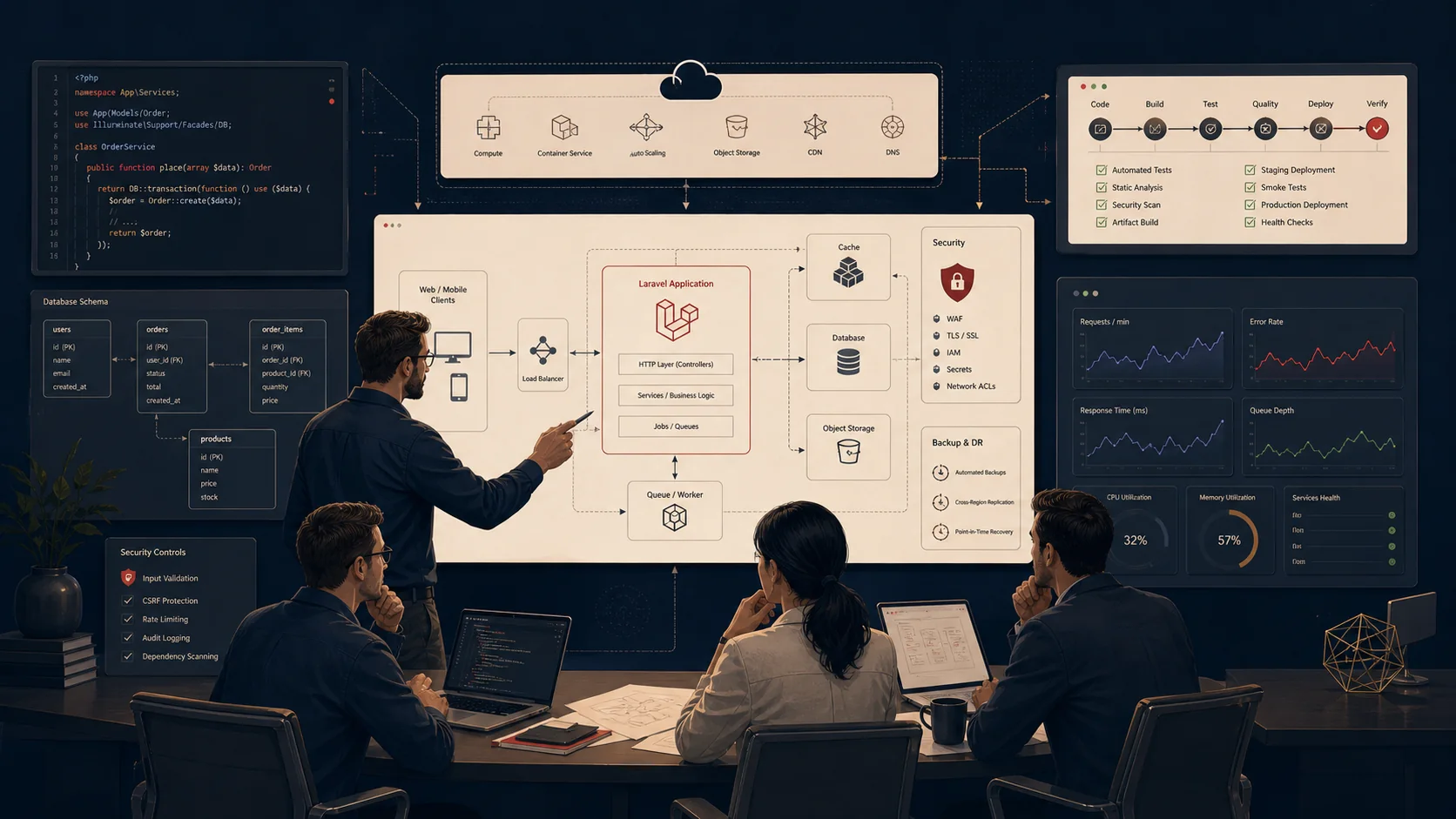
When a business hires someone to take over an existing Laravel application, it is not buying a clean-slate build. It is transferring responsibility for working software, business rules, customer data, integrations, infrastructure, and years of decisions—some documented, some hidden in code, and some known only by the people who use the system.
The right developer will not treat that history as an inconvenience. They will establish how the application creates value, identify what can fail, and make the system safer to change before promising a long feature roadmap. Whether the need is emergency repair, ongoing Laravel development services, custom Laravel development, or broader bespoke PHP development, the quality of the takeover often determines the quality of everything that follows.
This guide explains what a business should expect, which questions to ask, and why an inherited application rarely needs to be rebuilt simply because a new developer would have designed it differently.
Start with business continuity, not code style
An application can contain dated patterns and still run an essential operation reliably. It can also look orderly while hiding weak authorization, fragile deployments, or a payment integration that fails silently. A useful takeover therefore starts with business context.
The developer should learn which workflows create revenue, affect customers, move money, change inventory, send important messages, or support staff decisions. They should ask about recurring failures, manual workarounds, seasonal traffic, contractual commitments, and changes the business is afraid to release. This context separates meaningful risk from technical preference.
A rewrite-first recommendation made before this discovery is a warning sign. So is an estimate for a major expansion based only on a repository tour. Good developers can form early hypotheses, but they distinguish those hypotheses from verified facts.
Secure access before changing the application
Takeovers often expose an operational problem before a coding problem: nobody knows who controls the accounts. The source repository may belong to a former agency. Production access may depend on a shared password. DNS, email delivery, payment processing, storage, or cloud infrastructure may sit in accounts the business cannot administer.
Create an access inventory covering:
- Source control, issue tracking, and deployment systems
- Production, staging, and local environment requirements
- Cloud hosting, servers, containers, storage, DNS, and certificates
- Database administration, backups, and recovery locations
- Email, payments, analytics, error tracking, and monitoring
- OAuth applications, API providers, webhooks, and social platforms
- Domain registrar, app stores, and other business-controlled services
The business should own or administer these accounts. Give the new developer named, least-privilege access, use multi-factor authentication, and rotate credentials when the previous relationship ends. Secrets belong in environment or secret-management systems, not in source code, tickets, or email. Access control is part of a professional handoff, not a sign of distrust.
What a Laravel code audit should actually examine
A code audit should produce decisions, not a long list of opinions. Its output should identify urgent exposure, operational fragility, modernization opportunities, and the evidence behind each priority.
Framework, PHP, and dependencies
The developer should identify the PHP and Laravel versions, their support status, Composer constraints, abandoned packages, frontend dependencies, and custom forks. Running an old version is not proof the application is unsafe, but unsupported software narrows the available security and compatibility options. The audit should show the upgrade path and the dependencies likely to block it.
Application structure and critical workflows
Routes, controllers, services, jobs, commands, events, policies, middleware, and models reveal how work moves through the application. The goal is not to penalize every large class. It is to find where business-critical behavior is duplicated, tightly coupled, hard to test, or triggered through unexpected side effects.
A developer taking over custom PHP rather than a conventional Laravel codebase should perform the same mapping at the system level: entry points, session handling, database access, shared libraries, scheduled or detached processes, file storage, and external calls. The labels differ; the continuity questions do not.
Authentication, authorization, and data exposure
Security review should include login and password-reset behavior, role and permission enforcement, administrative routes, validation, file uploads, mass assignment, injection risks, cross-site request protection, session settings, secret handling, dependency advisories, and sensitive data in logs. Authorization deserves particular attention: a user being logged in does not mean they should be able to view or modify every record.
Findings should be ranked by exploitability and business impact. A public authorization flaw is more urgent than inconsistent formatting. The plan should also distinguish an immediate containment step from a durable correction.
Review the database as a business asset
The database is not merely an implementation detail. It may contain customer history, financial records, operational state, reporting logic, and assumptions accumulated over years. Before changing schemas or data, a new developer should understand relationships, constraints, indexes, data volume, retention requirements, and the reports that depend on existing definitions.
A responsible database review checks migration history against the real schema, identifies slow or repeated queries, examines missing constraints and inconsistent data, and confirms how backups are created, retained, and restored. A backup that has never been restored is an unverified hope, not a recovery plan.
Production data fixes need the same discipline as code releases: a bounded target, a preview or dry run when practical, a backup or rollback strategy, verification queries, and an audit trail. Large schema changes should account for table size, locking, deployment order, and compatibility between old and new application versions.
Map every integration and its failure behavior
Existing applications depend on systems outside the repository: payment gateways, CRMs, accounting tools, shipping services, email providers, AI services, social networks, cloud storage, and internal APIs. The new developer needs more than a list of vendor names.
For each integration, document who owns the account, how authentication works, which environments exist, what data crosses the boundary, where webhook requests arrive, how failed calls are retried, and how staff discover a failure. Confirm API version deadlines, rate limits, signature validation, timeout behavior, idempotency, and whether manual reconciliation is possible.
This work often explains apparently random bugs. An order may be valid locally but missing downstream. A webhook may have been delivered twice. An expired token may stop synchronization without creating a visible error. Experienced custom Laravel development includes designing for these external failure modes, not only making the successful request work.
Technical debt needs a business priority
Technical debt is not one number, and it is not everything an incoming developer dislikes. Some debt creates security exposure. Some slows every release. Some makes one rarely changed module unpleasant but harmless. Treating all of it as equally urgent produces expensive cleanup without a measurable business result.
A useful risk register connects each finding to impact, likelihood, evidence, and a recommended response. A practical order is usually:
- Contain immediate risk: exposed secrets, access failures, active errors, missing backups, or vulnerable public behavior.
- Stabilize delivery: reproducible environments, logs, targeted tests, and a deployment and rollback process.
- Protect critical workflows: add coverage around revenue, customer, and data-sensitive behavior.
- Modernize constraints: upgrade supported runtimes and replace dependencies that block future work.
- Improve while delivering: refactor the areas touched by valuable features instead of pausing the business for indefinite cleanup.
This gives leadership a portfolio of decisions rather than a frightening label. For the ongoing operational layer, see our guide to Laravel maintenance and support.
Deployment must be understood before the first release
A developer should not learn the production release process while an urgent fix is waiting. The takeover should establish how code is built, configured, migrated, deployed, verified, and rolled back. It should identify persistent files, background processes, cache behavior, environment differences, DNS or load-balancer dependencies, and any manual steps.
At minimum, there should be a safe place to validate changes, a versioned source of truth, a record of what was deployed, and a post-release check covering the affected workflow. Automated testing and deployment can improve this over time, but automation should encode a process the team understands. A complicated pipeline nobody can recover is not safer than a short, documented one.
Logging, error reporting, uptime checks, and infrastructure metrics should make failures visible. Agree on who responds, what qualifies as critical, and which provider owns problems that cross application and hosting boundaries. Custom PHP Design also provides AWS and Laravel DevOps services when the takeover includes delivery and infrastructure responsibility.
Avoid the unnecessary rebuild
Rebuilding can feel easier because the new code begins clean and familiar. The hidden cost is rediscovering every rule the old system already enforces: special pricing, exception handling, reports, permissions, imports, edge cases, and staff workarounds. The business must also migrate data, operate two systems during transition, and prove that the replacement behaves correctly.
Incremental modernization is usually the better starting assumption. Add tests around important behavior, isolate a fragile integration, replace an unsupported package, upgrade in controlled steps, or move one bounded workflow behind a clearer interface. These changes create value while preserving what already works.
A rebuild can still be justified when the current architecture cannot meet non-negotiable requirements, the platform or runtime has no viable upgrade path, the data model fundamentally blocks the product, or the cost and risk of staged repair clearly exceed replacement. The recommendation should include evidence, migration scope, a continuity plan, and total ownership cost—not simply the promise of cleaner code. Our legacy application modernization services are designed around that evidence-first choice.
What the first 30, 60, and 90 days can look like
First 30 days: access, map, and stabilize
Verify ownership and access, reproduce the application in a safe environment, learn critical workflows, review recent incidents, inspect logs and backups, map integrations, and identify urgent security or reliability risks. Deliver an inventory, risk register, and prioritized recommendation rather than pretending the entire system is already understood.
Days 31–60: prove the delivery process
Complete a bounded, valuable change. It might be a production defect, security correction, dependency blocker, or small workflow improvement. Add focused tests, document the release, deploy through the agreed process, and verify the result. This proves how the new relationship works under real conditions.
Days 61–90: establish the roadmap
Use evidence from the audit and first delivery to estimate the next stage. Separate maintenance, modernization, and feature development so leadership can see where capacity is going. Define a realistic upgrade sequence, monitoring improvements, integration work, and the product outcomes the business wants next.
The timeline will vary with system size and urgency. The principle is more important than the calendar: reduce uncertainty before making large commitments, then build confidence through controlled delivery.
How to evaluate a developer for an inherited application
Ask for examples of systems they took over, not only systems they built. A strong candidate should be able to explain how they investigated unfamiliar behavior, protected production data, prioritized debt, handled incomplete documentation, and earned enough confidence to release a change.
Useful questions include:
- What would you need in order to assess this application responsibly?
- How do you separate urgent risk from stylistic preference?
- How would you verify the database backups and recovery process?
- What would make you recommend a rebuild instead of phased modernization?
- How do you test a critical workflow with little existing coverage?
- How do you release and roll back a database-dependent change?
- How will findings, decisions, credentials, and deployment steps be documented?
- Who supports the application after the first project ends?
Look for calm specificity. Absolute promises before access, dramatic criticism of the previous developer, or a plan centered on replacing everything are poor substitutes for evidence. If you are comparing the broader scope of providers, use our custom Laravel development services buyer’s guide.
Choose a first engagement that creates usable evidence
A paid takeover assessment is often the most sensible first contract. Define the systems in scope, the access available, the known concerns, and the decisions the audit must support. Expected deliverables might include an architecture map, access inventory, version and dependency review, security findings, database observations, integration inventory, deployment assessment, risk register, and phased roadmap.
The assessment should not become endless discovery. Agree on a bounded period and a clear output, then select the first implementation milestone. Estimates will still contain assumptions, but they should become more reliable because they are tied to inspected code and observed operations.
For ongoing work, define capacity, prioritization, communication, incident expectations, intellectual property, account ownership, and handoff responsibilities. Our guide to hiring a long-term PHP developer covers those relationship mechanics in more detail.
Frequently asked questions
Can a new developer take over an existing Laravel application?
Yes. Existing applications change hands regularly. A responsible developer begins with access, business workflows, architecture, data, integrations, deployment, and operational risk before making major changes.
Should an existing Laravel application be rebuilt?
Not automatically. Stabilization and phased modernization often preserve working business logic with less cost and risk. Rebuild only when evidence shows the existing foundation cannot reasonably meet important requirements.
What should a Laravel application audit include?
It should cover critical workflows, versions and dependencies, authentication and authorization, database health, integrations, tests, deployment, infrastructure, monitoring, backups, recovery, documentation, and account ownership.
How long does it take to understand an existing PHP application?
It depends on size, age, documentation, tests, integrations, access, and technical debt. A bounded assessment can identify major risks quickly, while reliable estimates for complex changes require deeper investigation.
What should a business provide to a new Laravel developer?
Provide controlled access to the repository, environments, logs, vendor accounts, documentation, known issues, and people who understand the workflows. Keep the business in control of its code, domain, infrastructure, data, and provider accounts.
Need an experienced partner to take over your Laravel application?
Custom PHP Design helps businesses inherit, repair, maintain, modernize, and expand production Laravel and custom PHP applications. Engagements can begin with a focused audit, an urgent stabilization project, or a defined roadmap for Laravel application development and custom PHP development services.
The goal is not to sell a rewrite. It is to understand what your application already does, protect the value inside it, and create a safer path for the work your business needs next. If you need a developer to take responsibility for an existing system, tell Custom PHP Design what is working, what is failing, and what needs to change.