Introduction
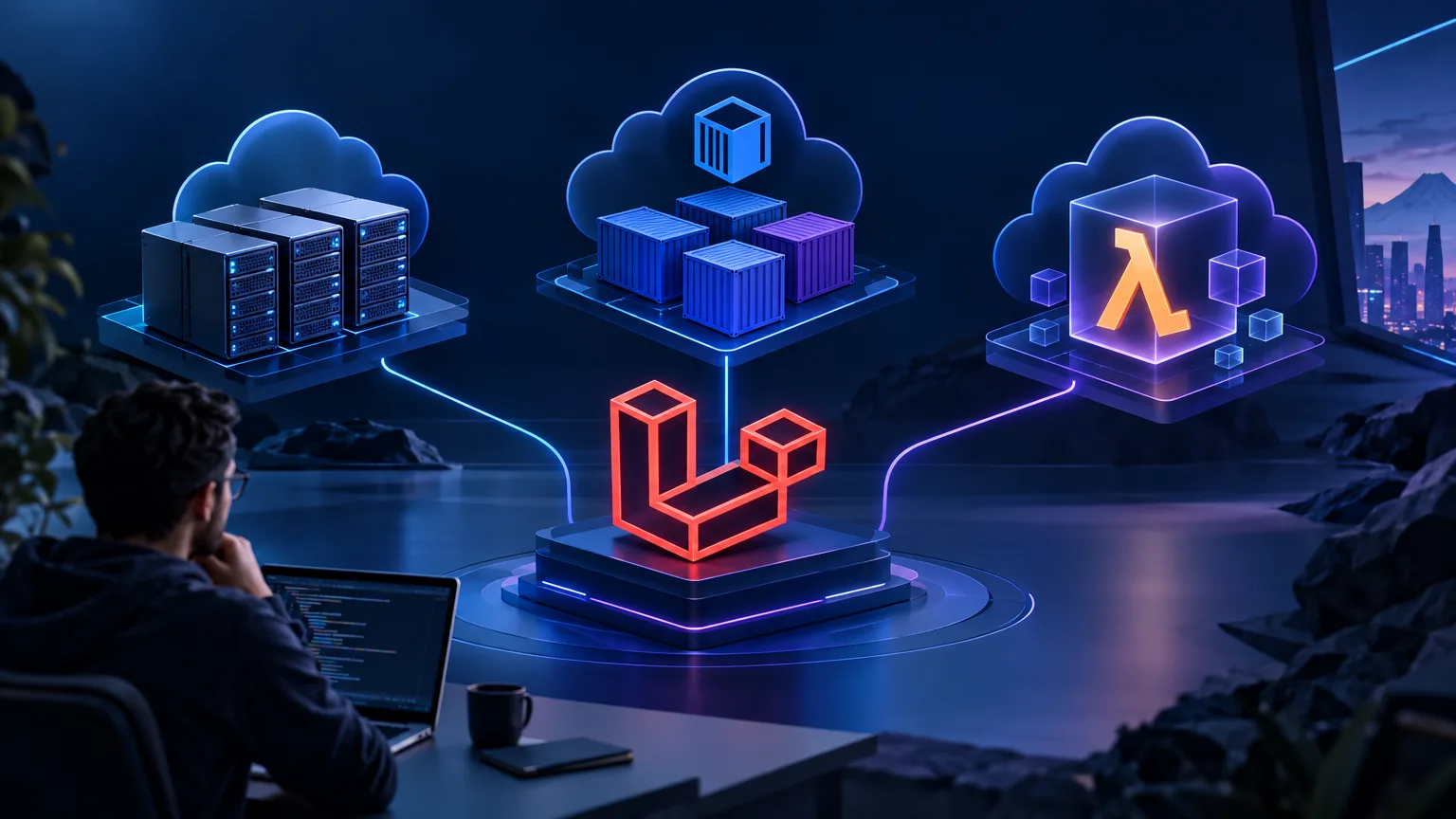
Choosing the right AWS hosting platform for your Laravel applications is a crucial decision that impacts cost, scalability, performance, security, and operational complexity. Business owners, CTOs, and technology leaders considering AWS for Laravel in 2026 face three prominent options: Amazon EC2 (Elastic Compute Cloud), AWS ECS Fargate (Elastic Container Service with serverless containers), and AWS Lambda (serverless functions).
This article provides a comprehensive comparison of these platforms tailored to Laravel workloads. We explore their advantages, limitations, pricing models, scalability, security implications, and maintenance overhead—from a technically grounded perspective informed by extensive experience with Laravel, AWS, Docker, CI/CD pipelines, and infrastructure automation.
Understanding the AWS Options for Laravel
Amazon EC2
Amazon EC2 provides raw virtual machines (instances) running in the cloud. It offers complete control over the server environment, allowing you to install PHP, Laravel, web servers, databases, and any other software components.
Key characteristics:
- Full OS-level access and customization
- Choice of instance size, storage, and operating system
- Manual or automated scaling with additional setup (Auto Scaling groups)
- Direct control over networking, security groups, and load balancers
AWS ECS Fargate
ECS (Elastic Container Service) Fargate lets you run Docker containers without managing servers. It abstracts infrastructure management by handling server provisioning, patching, and scaling automatically.
Key characteristics:
- Runs containers defined by Docker images
- Serverless in terms of infrastructure management
- Scales based on task definitions and service configurations
- Integrates with AWS Application Load Balancers and CloudWatch
AWS Lambda
AWS Lambda is a fully managed serverless compute service that runs your code in response to events and automatically scales. In a Laravel context, this typically means running stateless functions for API endpoints or using Laravel Vapor or similar solutions to adapt Laravel’s architecture to Lambda’s execution model.
Key characteristics:
- Event-driven, no server management
- Billed per execution time and memory used
- Limited execution time per invocation (max 15 minutes)
- Cold start delays impacting latency for some workloads
- Requires adapting Laravel apps to stateless, event-driven paradigm
Comparing Laravel Hosting on EC2, ECS Fargate, and Lambda
Pricing Considerations in 2026
Costs vary widely based on application traffic, instance size, and usage patterns.
- EC2: Best for consistently high workloads needing dedicated servers; potentially costly for unused capacity.
- ECS Fargate: Cost-effective for variable workloads; pay for actual container compute time.
- Lambda: Ideal for intermittent workloads or event-driven architectures; can be cheapest if invocations are spiky and bursts are handled efficiently.
For example, a SaaS platform with steady traffic may find EC2 or ECS Fargate more predictable for budgeting compared to Lambda's pay-per-invocation model.
Security and Compliance
All three services integrate tightly with AWS Identity and Access Management (IAM) for access control. However, responsibilities differ:
- EC2 instances require traditional OS patching and firewall configuration.
- ECS tasks benefit from AWS-managed infrastructure updates but require container image security best practices.
- Lambda functions run in highly controlled AWS environments limiting attack surface; code-level security is paramount.
For regulated industries, container orchestration platforms like ECS Fargate may offer a strong balance between control and managed security.
Scalability and Performance in Depth
EC2 instances offer reliable, consistent performance with the option to vertically scale CPU and RAM by switching instance types or horizontally scale with auto scaling groups. However, scaling often involves delays due to instance start-up times, and over-provisioning is common to handle peak loads.
ECS Fargate runs containers that can be scaled dynamically via service auto scaling rules. Startup latency is usually in seconds, enabling responsive scaling without managing servers.
AWS Lambda scales near instantaneously on demand without any user intervention. Be mindful of cold starts, which can add latency to infrequent function calls, although provisioned concurrency can mitigate this.
Deployment and Maintenance Complexity
Deployment strategies vary by platform and greatly influence operational efficiency:
- EC2: Typically involves setting up instances using AMIs or automation tools like Ansible and deploying Laravel via CI/CD pipelines. Maintenance includes OS patching, PHP version upgrades, and security updates.
- ECS Fargate: Requires creating Docker images for the Laravel app with proper environment configurations, setting up ECS task definitions, and deploying through pipelines such as AWS CodePipeline or third-party tools.
- Lambda: Laravel must be architected to handle stateless execution; frameworks like Laravel Vapor simplify deployment workflows integrating serverless best practices.
Practical Laravel Use Cases for Each AWS Option
1. Small Businesses and Startups
Often prioritize simplicity and cost-effectiveness. ECS Fargate offers serverless container management without the overhead of server maintenance, enabling fast deployment and scaling without upfront infrastructure investment.
2. SaaS Applications
Require predictable performance and robust scaling. EC2 or ECS Fargate are strong candidates depending on the effort available for infrastructure management. For well-architected microservices, ECS Fargate helps accelerate deployment agility, while EC2 suits those needing full OS control.
3. Enterprise Workloads
Demand strict compliance, security, and control. EC2 instances with hardened security and dedicated resources provide maximum customization. ECS Fargate can be suitable for containerized microservices, but serverless Lambda adoption depends on workload characteristics.
Real-World Example: Deploying Laravel on ECS Fargate with Docker
FROM php:8.2-fpm-alpine
RUN docker-php-ext-install pdo pdo_mysql
WORKDIR /var/www/html
COPY . .
RUN composer install --no-dev --optimize-autoloader
CMD ["php-fpm"]
This simple Dockerfile builds a Laravel-ready PHP container optimized for ECS Fargate, emphasizing minimal size and performance. Deploying it involves creating ECS task definitions, specifying resource requirements (CPU, memory), and linking to an Application Load Balancer for HTTP traffic.
Recommendations
- Choose EC2 if: You need full control over the OS and environment, require specialized software, or expect consistently high traffic.
- Choose ECS Fargate if: You want scalable containers with simplified management and your team is comfortable with containerization.
- Choose AWS Lambda if: You want to build highly scalable, event-driven applications with minimal server maintenance, and your workloads fit within Lambda’s execution constraints.
For more tailored support, consider engaging Custom PHP Design’s experts for custom PHP development and advanced AWS infrastructure solutions including AWS Laravel DevOps services and application modernization.
Frequently Asked Questions (FAQ)
Can Laravel applications run well on AWS Lambda?
Yes, but with adaptations. Laravel’s traditional stateful architecture must be refactored or supplemented with serverless frameworks like Laravel Vapor to handle Lambda's stateless, ephemeral nature and 15-minute execution limit.
Is ECS Fargate easier to manage than EC2?
Generally yes. ECS Fargate abstracts infrastructure management allowing developers to focus on container images and task definitions, whereas EC2 requires managing OS-level infrastructure.
How does pricing compare between these AWS services?
EC2 pricing is based on provisioned instance uptime, ECS Fargate charges per vCPU and memory used by containers, and Lambda charges per invocation time and resources used. Your workload patterns heavily influence which is most cost-effective.
What about security compliance on these platforms?
All are capable of high security compliance levels, but EC2 requires more active management. ECS Fargate and Lambda benefit from managed infrastructure and automated patching, reducing operational security burdens.
Conclusion
There is no one-size-fits-all answer for hosting Laravel on AWS. Your business needs, technical expertise, workload patterns, and compliance requirements will shape the choice:
- EC2 remains a powerful option for maximum control and legacy support.
- ECS Fargate blends container flexibility with infrastructure simplicity, great for modern apps.
- Lambda offers ultra-scalable event-driven execution but requires architectural adjustments.
Choosing the right platform influences your application's scalability, cost efficiency, and maintainability. Our team at Custom PHP Design can help architect a solution optimized for your unique Laravel workloads and provide ongoing consultation and development to ensure success on AWS.