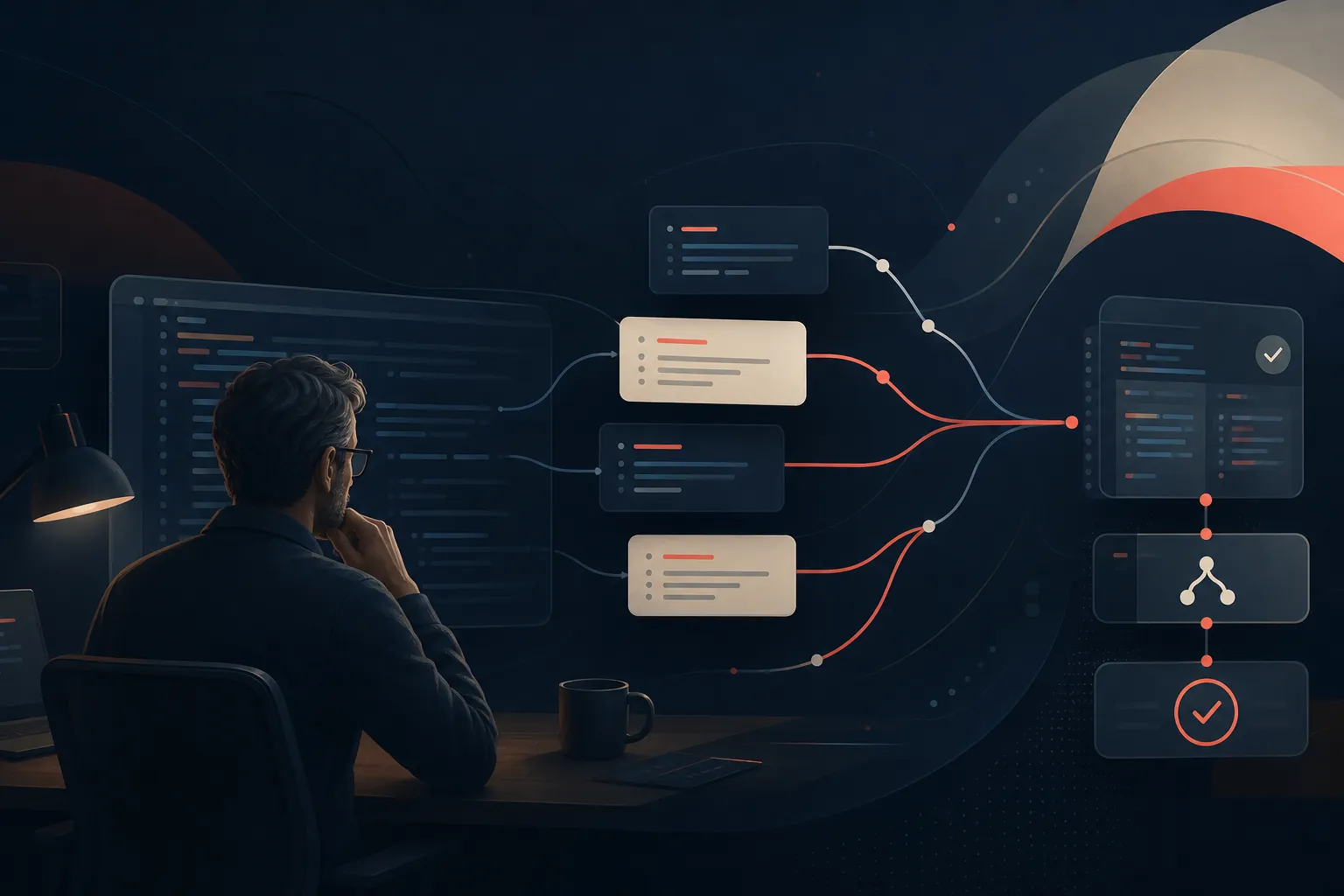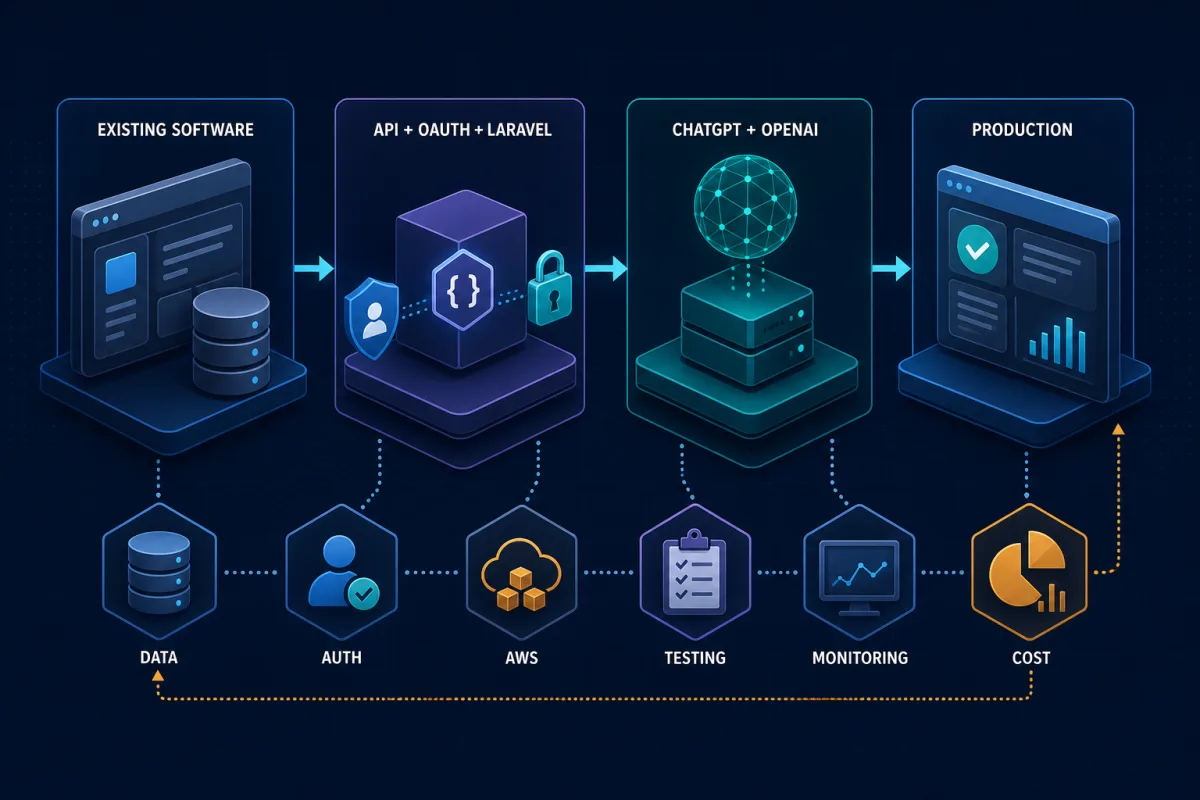
The OpenAI API usage fee is often one of the smallest parts of a real ChatGPT integration cost. The larger investment is connecting AI safely to an application’s users, permissions, business logic, databases, APIs, workflows, and production infrastructure.
A demonstration can send text to a model in an afternoon. A production feature must decide which user may send which data, limit that data to what the task needs, recover from provider failures, validate the answer, control spend, and fit the software the business already operates. Calling the model is easy. Integrating it safely into the business is the engineering work.
This guide provides planning ranges rather than fixed quotes. A useful estimate for ChatGPT integration services begins with the existing application and a defined workflow—not with token prices alone.
Why There Is No Single ChatGPT Integration Price
“Add ChatGPT” can describe radically different projects. A text box that summarizes a pasted note may need one server-side model call and a simple interface. An assistant that retrieves customer records, respects account permissions, coordinates several systems, and updates a workflow needs identity, APIs, authorization policies, validation, audit records, monitoring, and failure recovery.
Scope is also shaped by what already exists. A well-tested Laravel application with clear services and policies offers dependable places to connect AI. An undocumented PHP system may require discovery and a new boundary before the same feature can be added safely. That does not mean the legacy system must be rewritten; it means the estimate must include the work required to understand and isolate the relevant behavior.
Before discussing a price, define the user, workflow, permitted data, desired output, acceptable error rate, human review, expected volume, and production environment. Those answers reveal more than the phrase “ChatGPT integration.”
Major Factors That Drive AI Integration Cost
1. Integration complexity
A focused summarization, classification, drafting, or structured-extraction feature has a small surface area. The application provides bounded input, requests a known output, validates it, and shows it to a user. The project still deserves security and failure handling, but the workflow is easy to reason about.
Cost increases when AI needs customer records, several data sources, external APIs, multiple steps, or write access. A sales assistant that summarizes an account is simpler than one that reads CRM history, checks inventory, prepares a quote, creates follow-up tasks, and sends a message. Each additional system adds contracts, credentials, failure modes, permissions, and tests.
2. OpenAI API vs. GPT Actions
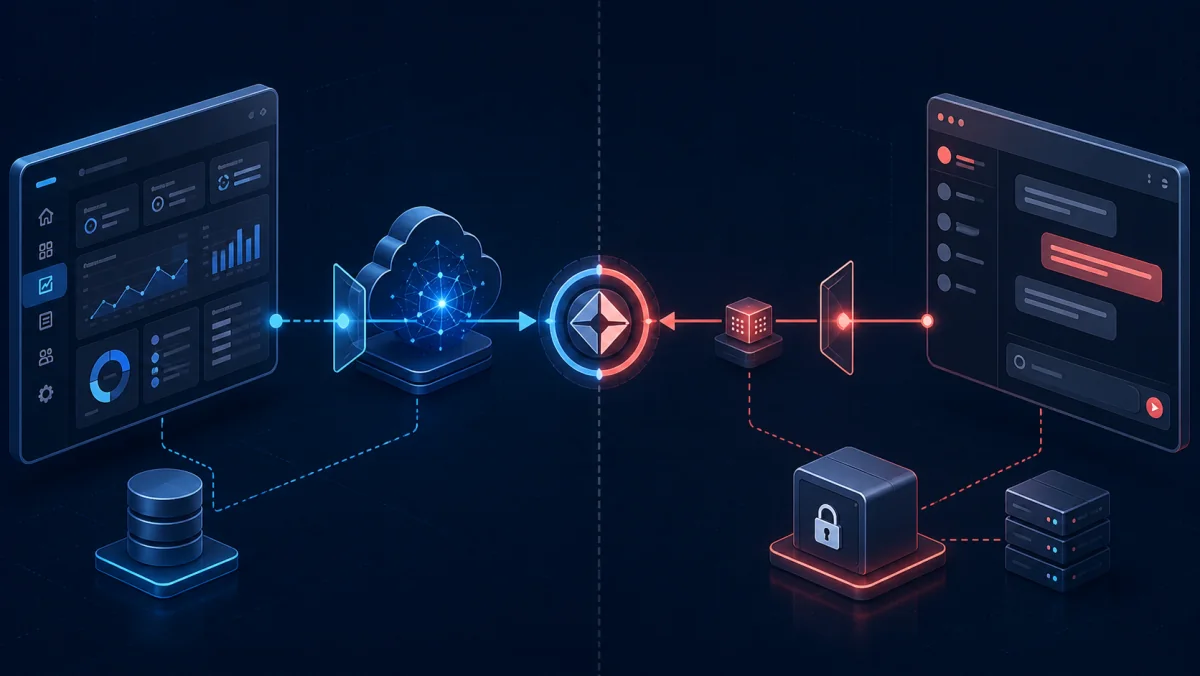
An application-driven OpenAI API integration begins inside existing software. The signed-in user requests a feature, the application selects authorized context, calls OpenAI on the server, validates the result, and presents or stores it.
A GPT Action reverses the direction. The user starts in ChatGPT, and the custom GPT calls a business API described by OpenAPI. Private account data may require OAuth, scopes, account linking, token management, and strict server-side authorization.
The two approaches can share business services, but they require different interfaces and threat models. Read our comparison of GPT Actions vs. the OpenAI API and the implementation guide for Laravel GPT Actions with OAuth and APIs.
3. Existing application quality
A structured Laravel application may already separate controllers, services, policies, APIs, jobs, and tests. Engineers can place the AI service behind an interface, reuse authorization, and verify existing behavior. Clean boundaries reduce discovery and regression risk.
A tightly coupled legacy PHP system can take longer because data access, HTML output, and business rules may be mixed together. The practical answer is often an incremental API or service boundary around one workflow—not a wholesale rewrite. Our guide to integrating ChatGPT into existing software shows why the current system can remain the source of truth.
4. Authentication and authorization
A public drafting tool has different requirements from a feature that handles private customer information. Existing Laravel authentication can identify users, while policies and gates determine what each user may do. Server-to-server API keys can authenticate a trusted system but should not be treated as user-level authorization.
GPT Actions may add OAuth 2.0, Laravel Passport, redirect and account-linking flows, scopes, access and refresh tokens, expiration, revocation, and consent. A valid token is only the beginning: every endpoint must still enforce tenant, ownership, role, and record-level policies. More sensitive access means more implementation and more adversarial testing.
5. Database and application data access
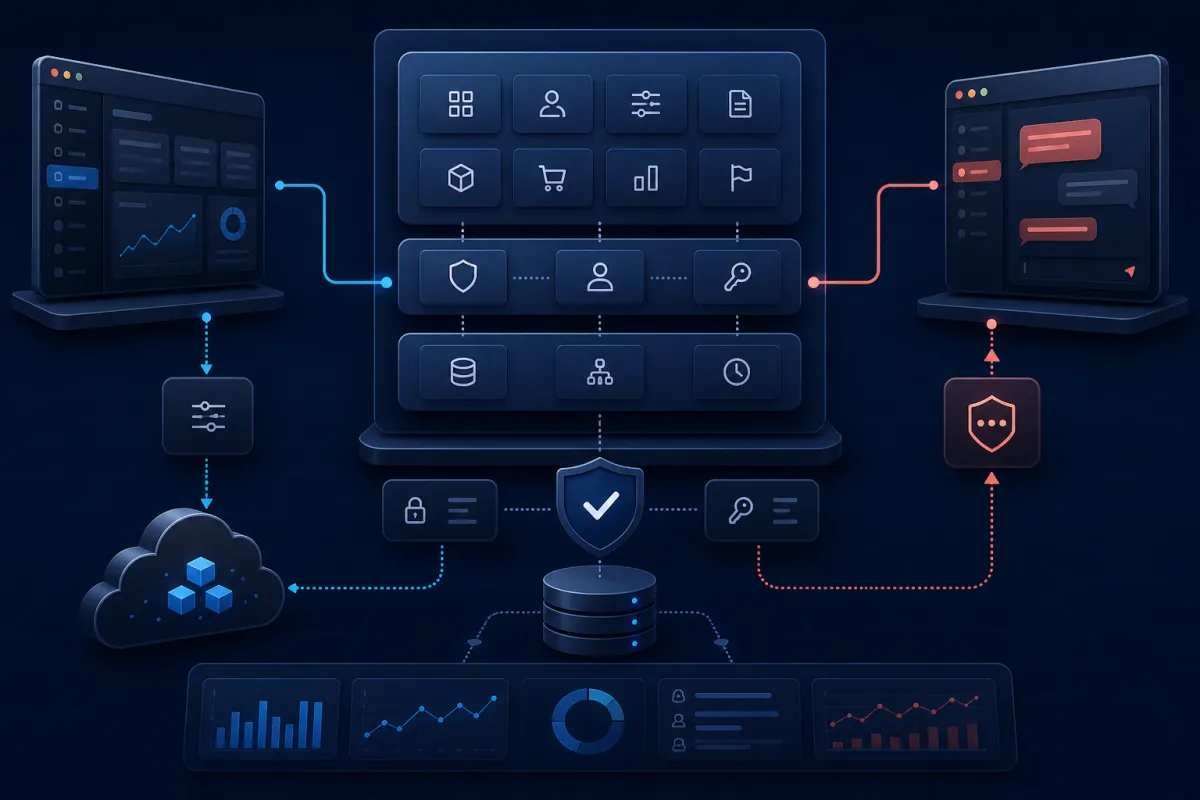
ChatGPT generally should not receive unrestricted database access. A controlled application service should select the minimum data needed, remove unnecessary sensitive fields, enforce tenant isolation, and present a stable structure. The model response should then be parsed and validated before the application relies on it.
Natural-language reporting becomes expensive when business definitions are unclear. Revenue, active customer, renewal risk, and available inventory should be computed by governed services or approved queries—not improvised by a model. Auditability improves when the system can record the authorized source, safe request metadata, model and prompt version, validated output, and approving user.
6. Background processing and queues
Large documents, batch classification, multi-step analysis, and slow provider calls should not hold an HTTP request open indefinitely. In conventional Laravel deployments, jobs and queues can provide retries, timeout controls, rate-limit handling, idempotency, progress tracking, and failure recovery.
The execution model must match the deployment. Some self-contained applications do not operate persistent queue workers; they can start authenticated, detached server-side processes or use an external managed execution mechanism instead. Either way, deferred work needs observable state, bounded retries, safe reprocessing, and a user-facing failure path. The cost is driven by reliability requirements, not by the word “queue.”
7. Infrastructure and AWS
Production implementation may involve EC2 or ECS for the application, Lambda for suitable event-driven tasks, S3 for controlled document storage, managed queues where appropriate, a secrets manager, centralized logging, alarms, and dashboards. Existing AWS and Laravel DevOps foundations can reduce setup work.
The goal is not to add every AWS service. Architecture should match workload volume, latency, data sensitivity, recovery needs, and the team’s operating capacity. Cost controls may include per-user limits, request budgets, model selection rules, document-size limits, caching where valid, and alerts for unusual usage.
8. Testing and production hardening
AI output is probabilistic and external APIs fail. Testing must cover authorization, malformed structured responses, provider timeouts, rate limits, token exhaustion, prompt changes, account isolation, duplicated requests, and unsafe write attempts. Regression fixtures can show whether a prompt or model change improves one case while damaging another.
Production hardening also includes logging without leaking sensitive prompts, tracing request cost and latency, fallback behavior, feature flags, abuse limits, and operational documentation. Autonomous actions cost more to harden than human-reviewed drafts because the consequence of a wrong result is higher.
Example ChatGPT Integration Cost Ranges
These broad 2026 planning ranges describe common engineering scopes. They are not quotes, and they exclude ongoing model consumption unless specifically estimated. Existing code quality, requirements, data sensitivity, integrations, and acceptance criteria can move a project below or above them.
Simple focused AI feature: approximately $5,000–$15,000
Examples include summarization, classification, content drafting, or structured extraction attached to an existing application. The feature has one primary workflow, limited data, a defined output, straightforward authorization, and human review. A usable production slice includes validation, error handling, logging, usage limits, and deployment—not only a prompt.
Moderate application integration: approximately $15,000–$50,000
This category connects AI to authenticated users, application records, workflows, asynchronous processing, and business logic. It may include an AI service layer, several prompt or tool flows, role-based access, tenant controls, administration, usage tracking, tests, and production monitoring.
Advanced GPT Action or multi-system integration: approximately $35,000–$100,000+
An advanced implementation may include a custom GPT, OpenAPI design, OAuth, user-specific data, multiple Actions, new APIs, external systems, write confirmations, account isolation, and production monitoring. Existing OAuth and API foundations can lower the effort; building them safely from scratch increases it.
Complex AI-enabled SaaS platform: approximately $75,000–$250,000+
Here AI is a major product capability rather than a single feature. Scope may include subscriptions, usage accounting, multiple AI workflows, document pipelines, administration, analytics, asynchronous execution, model routing, abuse protection, scalable infrastructure, and ongoing product iteration. A platform estimate should be phased because product learning will change later requirements.
Do not choose a category by budget alone. A short discovery review should map the existing application and identify the smallest useful boundary. That produces a more defensible estimate than a universal per-feature price.
Development Cost vs. OpenAI Usage Cost
Development and integration cost pays for engineering: discovery, architecture, interfaces, prompts, APIs, OAuth, policies, data selection, validation, tests, deployment, monitoring, documentation, and project delivery.
OpenAI usage cost is the recurring model consumption after launch. It typically depends on the selected model, input tokens, output tokens, request volume, tool usage, and any supporting storage or retrieval services. Longer context, large documents, frequent requests, and verbose output increase consumption.
A smaller or faster model may be sufficient for classification while a more capable model is reserved for difficult reasoning. Usage budgets, concise context, structured outputs, request caps, and measurement can keep recurring spend proportional to value. Because models and prices change, review the current OpenAI pricing page for exact costs rather than building a business case around a hard-coded figure.
Why a Proof of Concept Costs Less Than Production
A proof of concept answers a narrow question: can a model produce useful results on representative examples? It may use hand-selected data, one developer account, a temporary prompt, and manual retries. That is appropriate for learning.
Production must work for real users and imperfect inputs. It needs authentication, authorization, privacy boundaries, predictable schemas, monitoring, rate limits, failure states, deployment, support, and regression testing. If it can change business data, it also needs confirmation, idempotency, audit records, and recovery. The difference is not cosmetic polish; it is the work that makes a promising demonstration safe and dependable.
A Practical Laravel Integration Example
Consider an existing Laravel business application whose account managers want AI-generated customer summaries. The user opens a customer record. Laravel authenticates the session and applies a policy. A service selects permitted activity, removes unnecessary fields, and sends a bounded request through an AI client. The model returns a structured result. Laravel validates the schema and customer identifier, stores approved metadata, and displays a draft linked to its sources.
The architecture is:
User → Laravel Application → Authorization → AI Service → OpenAI API → Structured Result → Laravel Validation → Database / Existing Workflow
If the business instead wants customers to ask for account information inside ChatGPT, the architecture becomes:
ChatGPT → GPT Action → OAuth → Laravel API → Authorization → Existing Business Logic → Customer Data
The second path adds a conversational entry point but does not bypass Laravel. The API still owns identity mapping, scopes, tenant isolation, validation, and record policies. For deeper implementation details, see how to integrate ChatGPT into an existing Laravel application.
What Can Make a ChatGPT Integration Less Expensive?
- Clean, documented APIs and Laravel service boundaries
- A clearly defined workflow and measurable success criteria
- Existing authentication, authorization policies, and tenant controls
- A narrow first release with human review
- Existing AWS infrastructure, logging, secrets, and deployment automation
- An established deferred-processing mechanism where the workflow needs it
- Good automated tests around the affected business behavior
- Starting with one useful feature instead of AI-enabling the entire application
The cheapest implementation is not necessarily the one with the fewest engineering hours. Reusing sound boundaries and limiting the first release reduces both initial scope and the cost of correcting production mistakes.
What Makes an AI Integration More Expensive?
- An undocumented legacy application or unclear business rules
- Missing authorization boundaries and complex multi-tenant data
- New APIs, external systems, or complicated OAuth account linking
- Multiple AI providers or model-routing requirements
- Large document ingestion, retrieval, and retention pipelines
- Real-time or high-volume processing with strict latency targets
- Compliance, audit, data residency, or approval requirements
- Autonomous write actions that can affect customers or money
- Complicated production infrastructure and limited observability
These factors do not make a project unwise. They indicate where discovery, controls, and staged delivery matter most. A business can often reduce risk by starting with read-only assistance or draft generation, then expanding after it has evidence about quality and usage.
Frequently Asked Questions
How much does a ChatGPT API integration cost?
A focused production feature may cost roughly $5,000–$15,000. Authenticated application integrations commonly fall around $15,000–$50,000, while advanced GPT Actions and multi-system projects can exceed $100,000. These are planning ranges, not fixed quotes.
How much does it cost to add ChatGPT to a Laravel application?
The cost depends on the feature, application structure, users, data, workflows, tests, and infrastructure. A narrow feature may fit the lower range; private records and consequential actions require more engineering.
Is the OpenAI API expensive to use?
For many focused features, initial API consumption is smaller than implementation cost. Ongoing spend varies by model, context length, output, frequency, and volume. Check OpenAI’s current pricing for exact rates.
Do GPT Actions cost more to build than a normal API integration?
Often, especially when the application needs new APIs, OpenAPI definitions, OAuth, account linking, scopes, and user-specific authorization. Existing foundations can reduce the difference.
Can ChatGPT be added to an existing application without rebuilding it?
Yes. A service or API boundary can usually be added incrementally while the existing application retains its business rules and data.
What affects the cost of an AI integration?
Workflow complexity, code quality, authorization, data sensitivity, tenant isolation, external systems, volume, infrastructure, testing, compliance, and write authority are major drivers.
Can you integrate ChatGPT with a legacy PHP application?
Yes. The first phase may isolate one workflow behind a service or API. A rewrite is not automatically necessary; discovery determines the safest boundary.
Does ChatGPT need direct database access?
No. Controlled application services should retrieve only authorized data and validate model responses before using them in the existing workflow.
How long does a ChatGPT integration take to build?
A focused feature may take a few weeks, a moderate integration one to three months, and an advanced platform several months. Existing application quality and decision speed affect the schedule.
Can we start with a small AI feature and expand later?
Yes. One workflow, one user group, narrow data, human review, and measurable outcomes create a practical foundation for later expansion.
Get a Practical Estimate for Your Existing Software
Have an existing application and want to know what adding ChatGPT would actually require? Custom PHP Design can review the application, identify the smallest useful integration boundary, and provide a practical implementation path.
Our Laravel and ChatGPT integration services cover OpenAI APIs, GPT Actions, OAuth, databases, custom PHP and Laravel development, AWS infrastructure, testing, and production operation. For broader application work, explore Laravel application development and custom PHP development services.
Discuss a production ChatGPT integration and get a scoped path based on the software, users, and business workflow you already have.