Introduction
Launching a robust Software as a Service (SaaS) platform built on Laravel is an intricate blend of strategic planning, focused engineering, and operational rigor. For business owners, technical leaders, and project managers, grasping a realistic timeline—from contract signature to initial production launch—is critical. Such clarity helps in managing expectations, allocating resources, defining milestones, and synchronizing go-to-market efforts with technical readiness.
Key Phases in a Laravel SaaS Platform Development Timeline
The lifecycle of a Laravel SaaS platform development project typically unfolds in multiple sequential and occasionally overlapping phases. Timelines vary widely by scope complexity, technical requirements, team capabilities, and client responsiveness. This expanded examination highlights each phase and explains vital implementation details, security considerations, operational best practices, and edge cases encountered.
1. Discovery and Requirements Gathering (1-3 weeks)
This foundational phase is essential for creating a shared vision and roadmap. It requires detailed collaboration among stakeholders — from executive sponsors to end users, product owners, and technical leads — to define clear, prioritized objectives.
- Key Activities:
- Structured stakeholder workshops to align on business goals, competitor analysis, and target market personas.
- User story mapping and feature prioritization sessions focused on establishing a Minimum Viable Product (MVP) and planning future scaling paths.
- Technical feasibility studies assessing API dependencies, third-party integration strategies, legacy data migration, and compliance requirements such as GDPR, HIPAA, or PCI-DSS.
- Risk management assessments centered around data security, authentication schemes, and anticipated operational load.
- Deliverables: A prioritized, detailed product backlog; wireframes or interactive prototypes; initial technical specification documents outlining system roles, workflows, and API contracts.
Assumption: High client availability enables rapid feedback and timely approvals. Stakeholder unavailability can delay requirements gating, pushing out subsequent phases.
2. Architecture and Technical Planning (1-2 weeks)
Following requirements freeze, senior engineers and architects define the solution’s blueprint, selecting the right Laravel-native and external technologies to meet business needs while ensuring scalability and security.
- Key Activities:
- Determining multi-tenancy approaches: choosing among single database with tenant_id segregation, separate databases per tenant, or fully separate server environments depending on isolation and performance requirements.
- Choosing asynchronous processing tools such as Redis queues or AWS Simple Queue Service (SQS) to offload background tasks like email dispatch and billing.
- Establishing caching layers with Redis or Memcached to alleviate database load and improve response times under heavy traffic.
- Defining deployment architecture leveraging Docker containers (using PHP 8.4-fpm-alpine) orchestrated by Kubernetes, AWS ECS, or Laravel Vapor for serverless scalability, and integrating Application Load Balancers (ALB) with Nginx or Apache since PHP-FPM cannot directly handle HTTP requests.
- Designing continuous integration and delivery (CI/CD) pipelines — using GitHub Actions, GitLab CI, or Jenkins — configured to automate testing, code analysis, and ensure zero-downtime deployments via Laravel Envoy or Vapor automation.
- Planning for regulatory compliance security controls such as encrypted data stores, audit logging, role-based access controls (RBAC), and data residency.
- Deliverables: Finalized architecture diagrams, infrastructure as code (IaC) scripts (e.g., Terraform or CloudFormation), secure data flowcharts, and clear development/production environment configurations.
3. Development Phase (8-16 weeks)
The development phase combines iterative Agile sprints with rigorous testing and integration efforts, producing an evolving feature set aligned with Laravel’s MVC architecture and modern frontend frameworks.
- Key Activities:
- Implementing authentication & authorization using Laravel Sanctum or Fortify with support for OAuth2 and Single Sign-On (SSO) to meet enterprise client requirements.
- Building tiered subscription billing integration with Stripe, Braintree, or PayPal, architected to comply with PCI-DSS and to support automated recurring payments and metered usage.
- Ensuring strict tenant data segregation through enforced middleware, database queries scoped per tenant, and encrypted storage where applicable.
- Integrating frontend solutions such as Vue.js or React with Laravel Blade templates, enhanced by TailwindCSS to deliver responsive, accessible user interfaces.
- Developing RESTful or GraphQL APIs for frontend consumption and third-party integrations, using Laravel's API resources and Passport or Sanctum for authentication.
- Applying automated testing strategies with PHPUnit for unit tests, Laravel Dusk for browser tests, and static code analyzers like PHPStan or SonarQube to maintain code quality and detect security flaws early.
- Frequent staging deployments mirroring the production environment to facilitate real-user testing, client feedback, and early defect detection.
- Deliverables: Feature-complete SaaS modules, integrated payment and API systems, comprehensive test suites, and initial user documentation drafts.
Security & Operations Note: Incorporate routine static and dynamic security testing tools, dependency vulnerability scans (e.g., using OWASP Dependency-Check), and plan for timely patching of Laravel and related components.
4. Testing and Quality Assurance (2-4 weeks concurrent or following development)
A dedicated QA phase escalates the rigor of testing beyond unit and integration levels, ensuring the platform meets production standards for performance, reliability, and security.
- Key Activities:
- Execution of functional test cases covering business logic, edge cases, and negative scenarios.
- Penetration testing that focuses on preventing tenant data leaks, validating input sanitization, and securing API endpoints against injection and unauthorized access.
- Performance and load testing using JMeter, Gatling, or Locust to simulate expected concurrency, billing batch jobs, and bulk API usage.
- User Acceptance Testing (UAT) involving client representatives to validate alignment with project requirements and UI/UX expectations before production rollout.
- Failover and disaster recovery drills including backup integrity verification, database failovers, and rollback procedure dry runs.
- Deliverables: QA test reports, penetration test summaries, signed client acceptance documents, and a backlog of deferred defects and minor enhancements.
5. Deployment Preparation and Launch (1-2 weeks)
This phase culminates preparation for a high-availability, secure production release with minimal downtime.
- Key Activities:
- Provisioning cloud infrastructure based on prior architecture, including auto-scaling policies, ALB setup, managed database services (e.g., AWS Aurora or Azure SQL).
- Setting up observability stacks with monitoring tools such as New Relic, Datadog, Sentry for real-time performance and error tracking.
- Implementing centralized log aggregation (e.g., ELK Stack, AWS CloudWatch Logs) for incident management and forensic analysis.
- Configuring DNS with providers like AWS Route 53 or Cloudflare to enable blue-green or canary deployments for zero-downtime cut-over. Managing SSL certificates either via Let's Encrypt or enterprise providers with automated renewal.
- Completing final data migration processes, including verification scripts ensuring data integrity from legacy environments or seed data preparation.
- Applying security hardening best practices: disabling debug/debugbar modes, applying strict HTTPS everywhere policies, configuring web application firewalls (WAF), and network firewall rules.
- Conducting multi-stakeholder go-live readiness reviews and checklists covering technical, business, and support perspectives.
- Deliverables: Live, fully operational SaaS platform, stakeholder go-live sign-off, public launch announcements, and documented rollback and incident escalation procedures.
6. Post-Launch Support and Iteration (Ongoing)
Post-launch is a critical stabilization phase, blending operational vigilance with iterative feature development driven by real user feedback.
- Key Activities:
- Monitoring system metrics and logs to detect anomalies, bottlenecks, and errors, with rapid incident response and resolution.
- Performance tuning informed by live usage including query optimization, horizontal scaling, and CDN configuration.
- Collecting and analyzing user feedback and behavior analytics to inform product backlog refinement and new feature sets.
- Scaling infrastructure dynamically in line with user growth and feature set evolution, leveraging cloud elasticity.
- Maintaining rigorous security patching and compliance audits as regulatory landscapes evolve.
- Deliverables: Regular updates and hotfixes, expanded user documentation, roadmap adjustments, and operational reports reflecting ongoing SLA adherence.
Example Timeline Summary
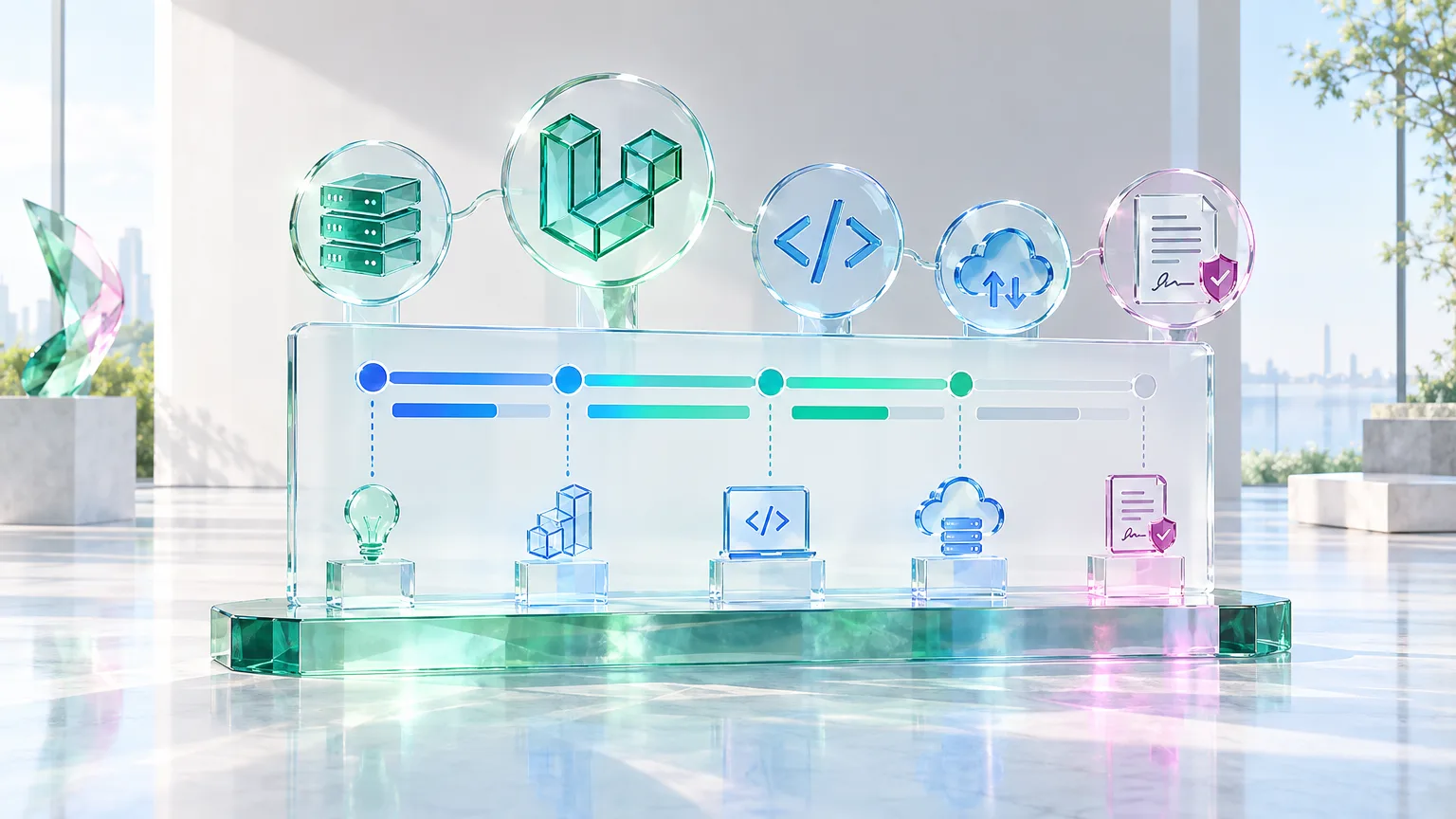
| Phase | Duration |
|---|---|
| Discovery and Requirements | 1–3 weeks |
| Architecture and Planning | 1–2 weeks |
| Development | 8–16 weeks |
| Testing and QA | 2–4 weeks |
| Deployment and Launch | 1–2 weeks |
| Total Realistic Timeline | 13–27 weeks (~3 to 6+ months) |
Critical Factors Affecting Timeline
- Project Scope Complexity: Complex SaaS features such as multi-region deployments, advanced data analytics, and live collaboration functionalities require extensive development and testing time.
- Team Experience and Size: Experienced Laravel engineers familiar with PHP 8.4, Laravel 10, and SaaS architectures accelerate development. Conversely, onboarding junior developers or new technology stacks increases timelines.
- Third-Party Integrations: Variability in external API quality, rate limits, and compliance (e.g., payment gateways, SMS platforms) often introduce unexpected delays.
- Client Availability and Communication: Agile feedback loops depend heavily on responsive client participation for design critiques, bug acceptance, and business rule clarifications.
- Hosting, Compliance, and Infrastructure Setup: Regulatory environments may require additional certifications, security audits, or infrastructure segregation, extending launch preparation phases.
Implementation Example: Insights from TheAppWizards.com
TheAppWizards.com serves as a practical illustration of efficient Laravel SaaS platform delivery. Their projects emphasize thorough early-stage architectural design, particularly around multi-tenancy to guarantee tenant data isolation and predictable performance at scale.
TheAppWizards embrace modern cloud-native practices using Laravel Vapor paired with AWS serverless infrastructure, enabling efficient on-demand scalability critical for SaaS platforms facing variable traffic patterns. This approach markedly reduces infrastructure management overhead at scale and improves cost efficiency.
Additionally, TheAppWizards prioritize automated testing integrated into CI/CD pipelines, enabling rapid feedback and minimizing deployment risks. This engineering discipline reduces the frequency and severity of post-launch incidents and supports faster delivery of iterative improvements.
For organizations planning their Laravel SaaS development journey, theAppWizards’ approach highlights the value of balanced architecture, rigorous automation, and methodical project phasing to compress timelines while ensuring security, maintainability, and performance.
Additional Technical Recommendations
- Use
php:8.4-fpm-alpineas the base image for Docker containers hosting Laravel PHP-FPM processes to leverage PHP 8.4 features and security patches optimized for production workloads. - Adopt event-driven system design utilizing Laravel Events and Listeners or external queues (e.g., AWS SQS) to enhance modularity and system responsiveness while isolating failures.
- Establish CI/CD pipelines with tools like GitHub Actions or GitLab CI combined with Laravel Envoy scripts for streamlined, automated test, build, and deployment workflows ensuring consistent and repeated releases.
- Integrate monitoring solutions including Sentry for real-time application error tracking and New Relic or Datadog for holistic performance insights and anomaly detection.
- Enforce stringent security measures including TLS-only access with HTTP Strict Transport Security (HSTS), Content Security Policy (CSP), input validation, role-based access controls (RBAC), and regular security audits.
Frequently Asked Questions (FAQs)
Q: Can a Laravel SaaS platform be delivered faster than 3 months?
A: Deploying a minimal viable product (MVP) with highly limited scope is feasible in 1–3 months, particularly when leveraging Laravel packages and pre-built modules. However, production-grade SaaS platforms focused on robustness, scalability, security, and compliance generally require at least 3–6 months.
Q: How do you estimate costs alongside timeline?
Cost estimations depend on defined project scope, engineering effort, hosting choices, third-party services, and operational overheads like DevOps and QA. Cloud costs vary by region, uptime Service Level Agreements (SLA), traffic patterns, and data egress volumes. Employing cloud provider calculators (e.g., AWS Pricing Calculator) and thorough workload analyses helps form accurate cost-time models.
Q: What role does client involvement play in timeline adherence?
Active, timely client engagement is pivotal to minimizing delays. Rapid feedback on deliverables, clear acceptance criteria, and proactive communication prevent rework and help maintain sprint cadence.
Q: Is Continuous Integration essential for Laravel SaaS projects?
Absolutely. CI automates critical tests and code quality checks, allowing rapid yet safe releases. It also detects regressions early, reducing technical debt and fostering developer confidence in continuous feature delivery.
Conclusion
Building a Laravel SaaS platform from signed contract to initial launch realistically spans 3 to 6 months, incorporating discovery, architecture, development, testing, and production deployment phases. Key variables such as project complexity, third-party integrations, team experience, and client interaction heavily influence this timeframe.
By applying best practices in multi-tenancy architecture, automated testing, CI/CD, and cloud-native infrastructure — exemplified by Laravel experts like TheAppWizards.com — development teams can compress timelines without sacrificing scalability, security, or reliability. Organizations should balance time-to-market pressures against quality and compliance requirements to ensure a successful SaaS product launch.
If your organization is embarking on a Laravel SaaS platform project and seeks experienced development partners to help navigate this timeline efficiently, consider exploring our Laravel application development services. Our team delivers customized solutions optimized for your business and technical objectives.