Traffic and compute spikes are different problems.
A product can have modest daily traffic while still needing serious bursts of CPU and memory during video processing.
Central Florida + Remote
Request a Free CallVidShare Case Study
VidShare uses AWS in a way that fits an early product: the web app stays focused on users, video processing runs on its own path, and the overall system stays understandable for founders who need real capability without overbuilding.
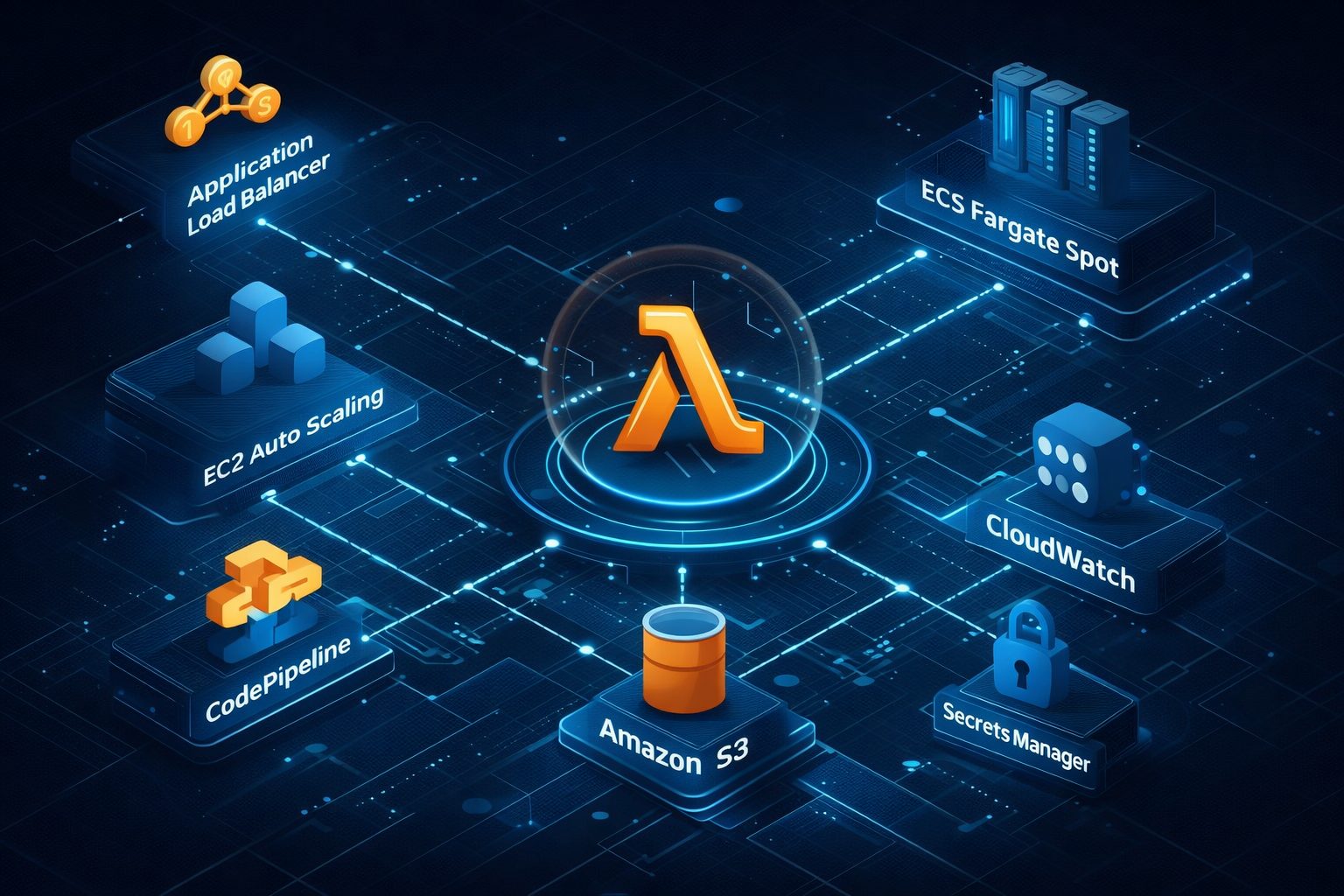
Architecture Snapshot
VidShare on AWS
Web App Tier
ALB + EC2 Auto Scaling keep user-facing traffic isolated from heavy video jobs.
Upload Path
Files land in S3 first, creating a reliable handoff point.
Trigger Layer
Lambda reacts to events and starts processing without becoming the processor.
Processing Tier
Dedicated ECS Fargate Spot tasks run one upload at a time, then write results back to S3.
Storage
S3 Originals + Outputs
Deployments
CodePipeline Flow
Visibility
CloudWatch Logs
VidShare is a good example of why media products need a different conversation than a normal CRUD app. The web side has to stay responsive for sign-ins, dashboards, and uploads, while the processing side has to absorb unpredictable compute-heavy video jobs without dragging the whole product down.
Traffic and compute spikes are different problems.
A product can have modest daily traffic while still needing serious bursts of CPU and memory during video processing.
Uploads should not compete with the web app.
If the same tier handles both, user experience and operational stability become harder to protect.
Founders still need something understandable.
The answer is not maximum complexity. It is a setup with clear boundaries, sane costs, and debuggable behavior.
Solution
The user-facing application lives on its own path so normal traffic is not dragged down by heavy media jobs.
Original files are stored in S3 first, which creates a durable handoff point for the rest of the workflow.
Lambda reacts to the upload event and starts the job. It is the trigger, not the video processor.
Each upload can get its own processing task, which is useful for isolation, retry behavior, and cost control.
Processed outputs return to S3 so playback, distribution, and downstream delivery can use the same storage base.
Logs and metrics make failures easier to trace, while deployment tooling stays understandable for a small SaaS team.
Architecture Flow
The point is not novelty. It is a reliable sequence with clear ownership at each step.
A creator uploads video through the web app without tying up the main application servers.
The original media lands in S3 first so storage stays durable and separate from the web tier.
A Lambda event reacts to the upload and starts the next processing step instead of doing heavy work itself.
A dedicated Fargate Spot task handles the actual video job, giving each upload its own isolated worker.
Completed renditions and derived assets are written back to S3 for downstream use and playback.
CloudWatch plus straightforward deployment tooling keeps failures visible and operations understandable.
Principles
The customer-facing app stays responsive because uploads and background media jobs are handled on separate paths.
Video workloads arrive unevenly, so spot-backed tasks help control cost without forcing permanent idle capacity.
This setup covers real operational needs without introducing unnecessary orchestration or platform theater too soon.
AWS Stack
Each piece has a job. Together they support uploads, processing, deployments, and visibility without pretending the product needs an enormous platform team.
Routes web traffic cleanly into the application tier.
Keeps the main app tier stable as normal traffic changes.
Acts as the event trigger between upload and processing.
Runs isolated video jobs only when compute is actually needed.
Stores original uploads and processed output in one durable place.
Keeps deployments structured and understandable for a small team.
Provides logs, metrics, and operational visibility.
Keeps application and integration secrets out of code and instances.
AWS Credits
For a founder still proving product-market fit, credits at that level can materially help cover experimentation, deployments, storage, and early infrastructure decisions. That does not remove the need for discipline, but it can create breathing room to build sooner and learn faster.
Custom PHP Design builds practical Laravel and AWS systems for products that need to ship, process real workloads, and stay understandable after launch. If your app has mixed workloads like VidShare, we can map out a version that is credible, scalable, and founder-friendly.